How to Wear a Vintage Brooch: Styling Inspiration from the 1930s to the 1950s
How to Wear a Vintage Brooch: Timeless Styling Tips Inspired by the 1930s, 1940s and 1950s.

Last updated on January 8th, 2026 at 11:34 am
- How to Wear a Vintage Brooch Inspired by Old Hollywood
- The Rise of the Costume Jewellery
- 1920s Brooch Style: Geometry, Modernity, and Art Deco Glamour
- 1930s Brooches: Romance, Movement, and Imagination
- 1940s Brooches: Strength, Symbolism, and Structure
- The 1950s Brooch: Glamour Returns
- Collector’s Sidebar: How I Spot a Good 1950s Brooch
- Betty Rose Suits: Quiet Power from the American Heartland
How to wear a vintage brooch is one of the questions I’m asked very often, and the answer lies in understanding how women styled these remarkable pieces from the 1930s through the 1950s.
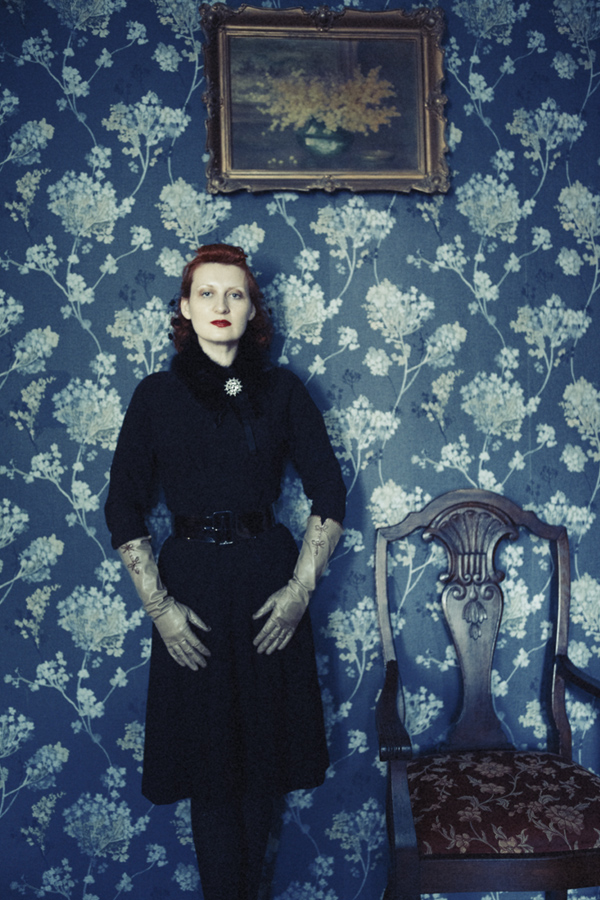
There is something irresistibly powerful about a vintage brooch, and I say that as someone who has lived with them for most of my life. No matter how small, a brooch carries decades of style, craftsmanship, and quiet audacity, and once you notice that, there’s really no turning back. I’ve always believed a brooch doesn’t simply finish an outfit; it defines it. It sets the tone, shifts the mood, and announces that what you’re wearing has been chosen carefully and with a purpose. Sometimes, I plan my vintage outfit around a brooch.
My own collection of vintage brooches is, by any reasonable measure, large, and it all began rather early. I was still young when my mother gifted me a handful of 1940s costume jewellery pieces, and that was it. One brooch led to another; curiosity turned into obsession, and before long, I found myself studying settings, materials, and decades with the same devotion that others reserve for shoes or handbags. Those early pieces taught me that beautiful, show-stopping jewellery doesn’t have to be made from precious materials or cost a fortune.
When I style a look, the brooch is never an afterthought. It becomes the focal point, the detail that quietly reveals who you are and what you know. A brooch can sharpen tailoring, soften severity, or inject wit where you least expect it. You should see some of the amusing novelty brooches popular in the 1940s! It invites conversation, rewards a second glance, and has an uncanny ability to make an outfit feel complete without trying too hard.
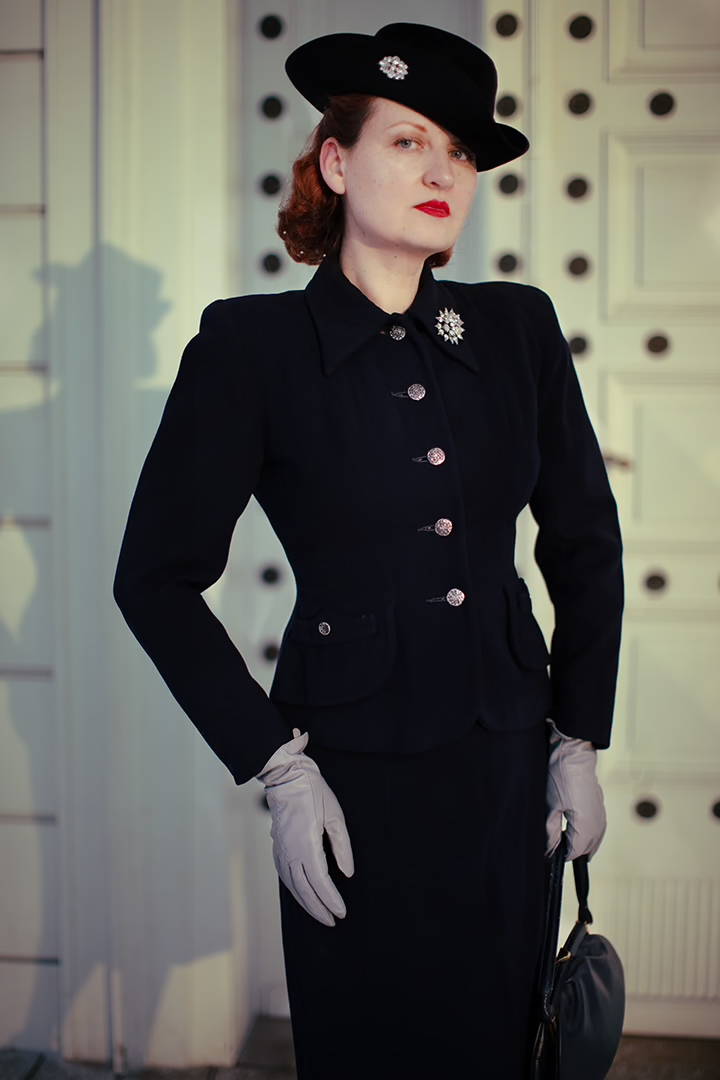
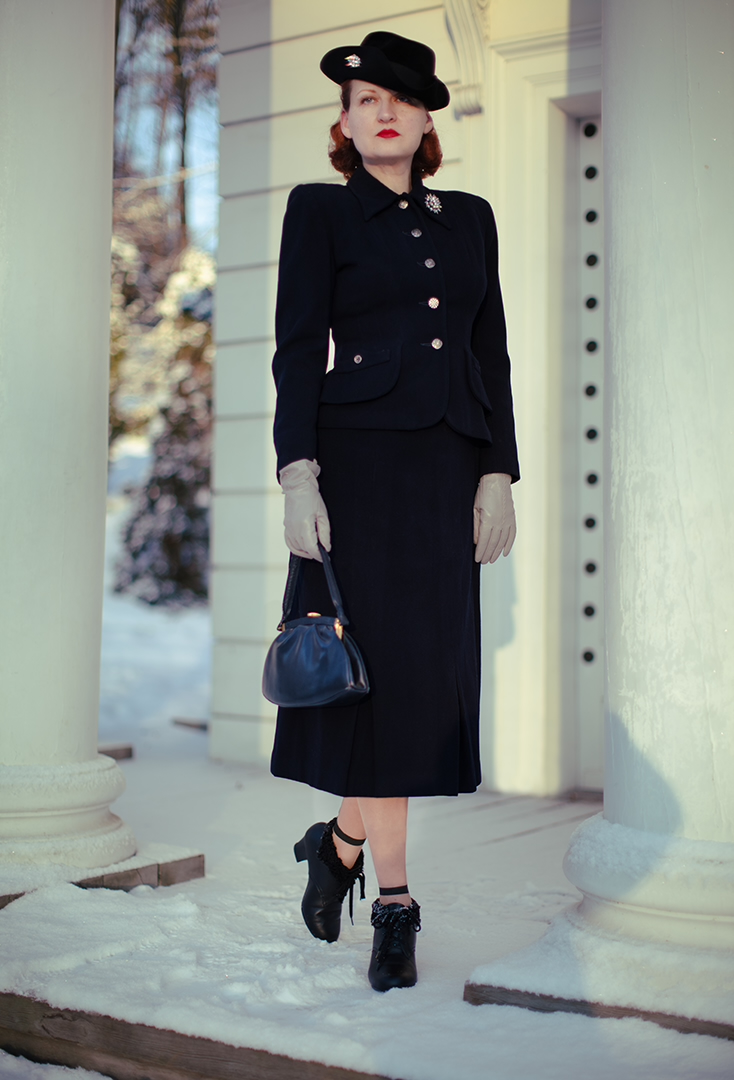
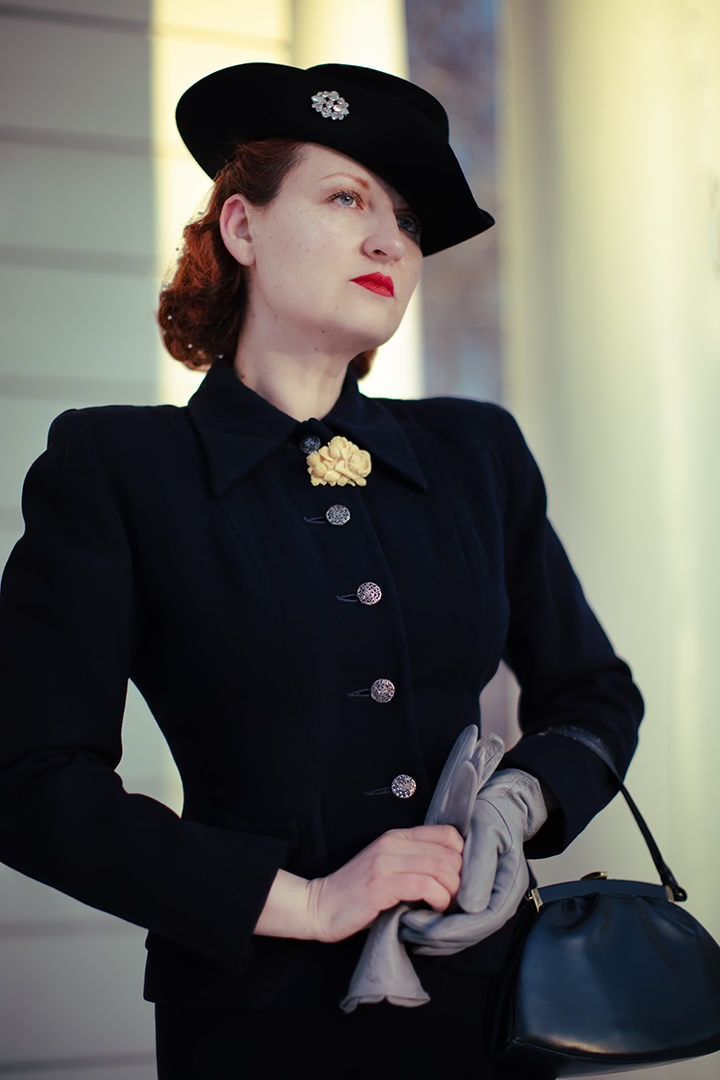
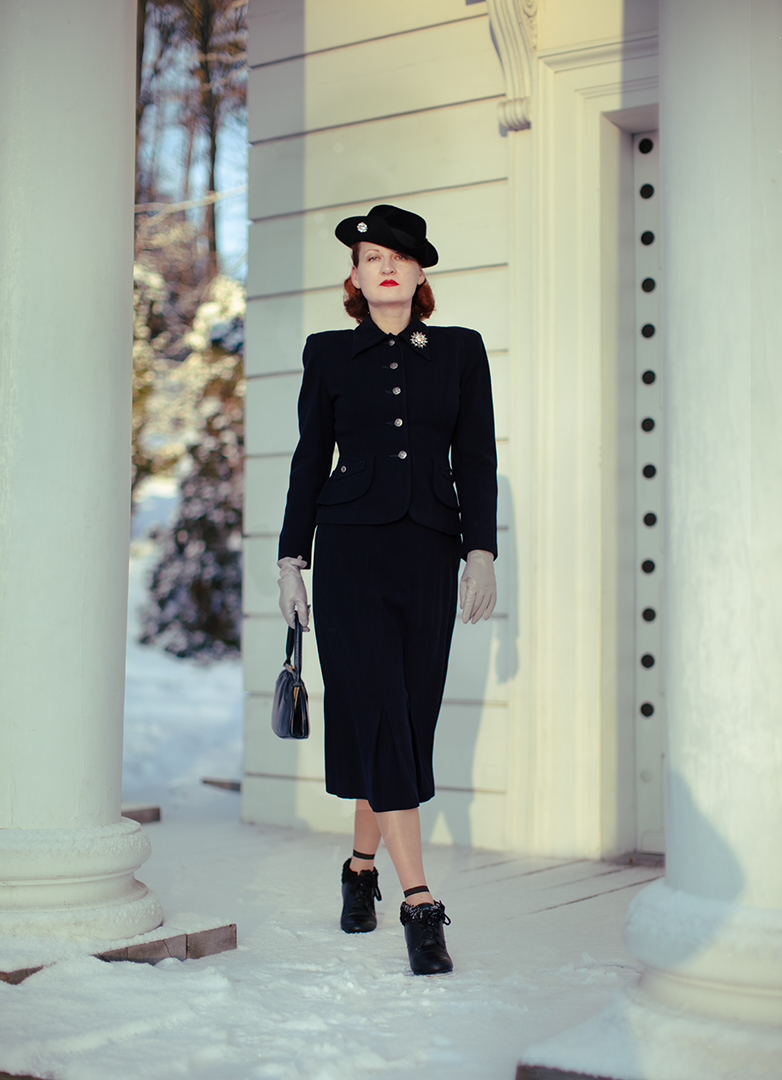
For the purpose of this post and the photo shoot, I’m wearing the new-to-me 1940s navy Betty Rose skirt suit, styled with a fedora hat I bought twenty-five years ago in Virginia, and a rotating selection of brooches from the 1930s, 1940s, and 1950s, each creating a completely different mood. And that’s what I love most about a vintage brooch: its versatility. With a simple change of placement, the entire look evolves — from casual to cinematic elegance, or full-blown dramatic femme fatale.
How to Wear a Vintage Brooch Inspired by Old Hollywood
When people ask me how to wear a vintage brooch, I always suggest starting with pictures or films of Old Hollywood movie stars, because the screen legends mastered the art of making one small detail feel deliciously dramatic.
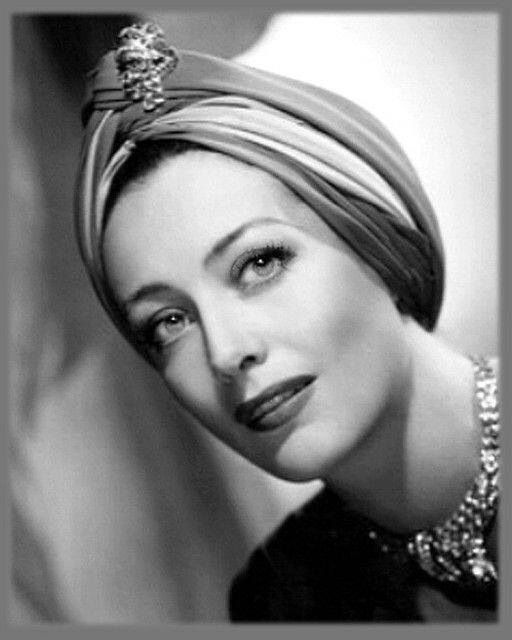
Joan Crawford, for instance, wore a brooch pinned to a turban with such confidence that it instantly turns any hat into a statement, a styling trick I still use when I want effortless glamour. I only wish that I looked as good wearing a turban as the beautiful Ms Crawford did.
If you’re wondering how to wear a vintage brooch in a more playful way, look no further than my beloved Bette Davis, who treated her accessories as punctuation, pinning them to bows and scarves to frame her face and command attention.

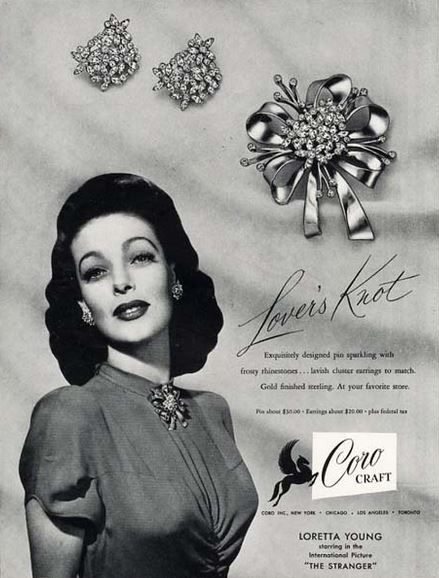
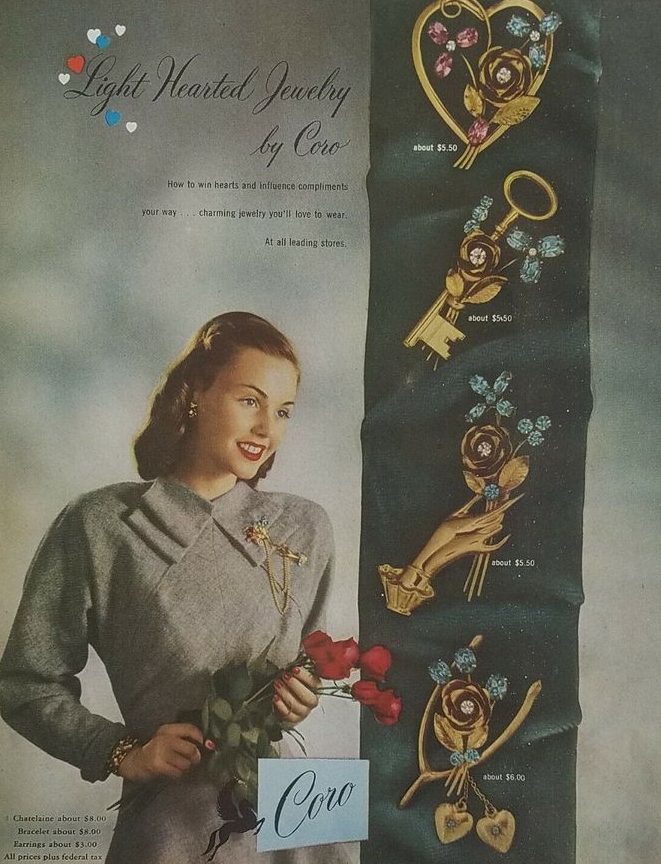
I’m also endlessly inspired by Loretta Young, especially in a Coro jewellery, my favourite costume-jewellery brand, advertisement where she wears a brooch at the neckline; it’s refined, elegant, and proof that knowing how to wear a vintage brooch, once again, is all about its placement.
SHOP VINTAGE CORO BROOCHES
Of course, the classic answer to how to wear a vintage brooch, pinned to a jacket collar, never fails, particularly with tailored 1940s suits or dresses. I also adore fastening a bold 1940s brooch to my faux fur shawl for a touch of unapologetic drama. Truly, once you understand how to wear it, the possibilities are endless, and that’s where the fun begins.
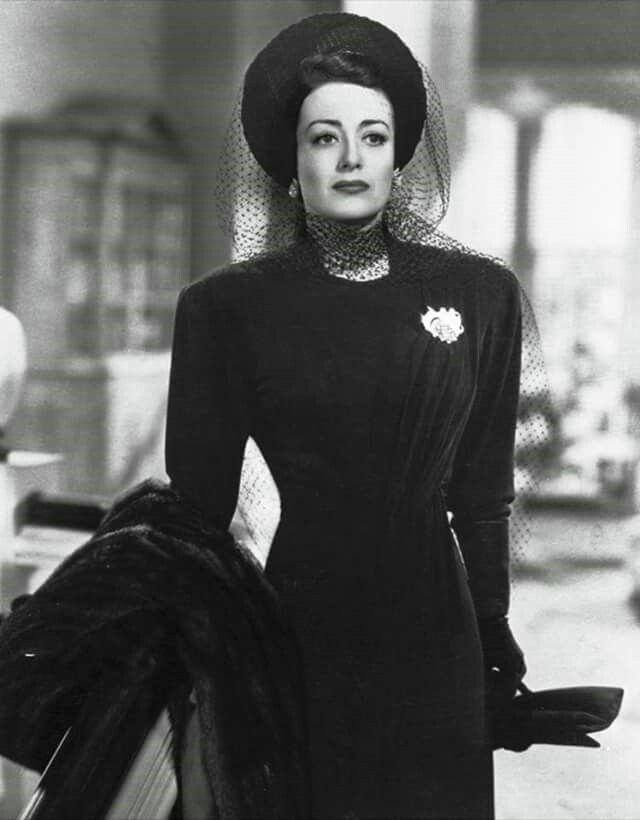
The beautiful 1940s brooch I’m wearing in the picture belonged to my very elegant late mother-in-law, who shared my passion for collecting them.
The Rise of the Costume Jewellery
I’ve always been fascinated by how costume jewellery reshaped the way women dressed and expressed themselves in the twentieth century.
Costume Jewellery in Vogue
Costume jewellery is in fact an entirely twentieth-century phenomenon; the term was first used in 1933 in the New Yorker magazine. Prior to that, it had been referred to in Vogue as ‘dress ornaments’ or ‘craftsmen’s jewellery.’
That shift in language reflects a much larger cultural change: new metals, plastics, and non-precious stones made jewellery more accessible, while its early association with theatrical costume gave it a sense of drama and experimentation that I find irresistible.
During the Art Deco period, innovation flourished, with clever designs like reversible day-to-night brooches and the much-loved dual clip, which appeared to be a single brooch but could be separated into two matching clips, a practical luxury women adored. What began as precious, high-end creations by fine jewellers quickly filtered into costume jewellery made for the wider public, marking the Art Deco movement as a true turning point in jewellery history.1
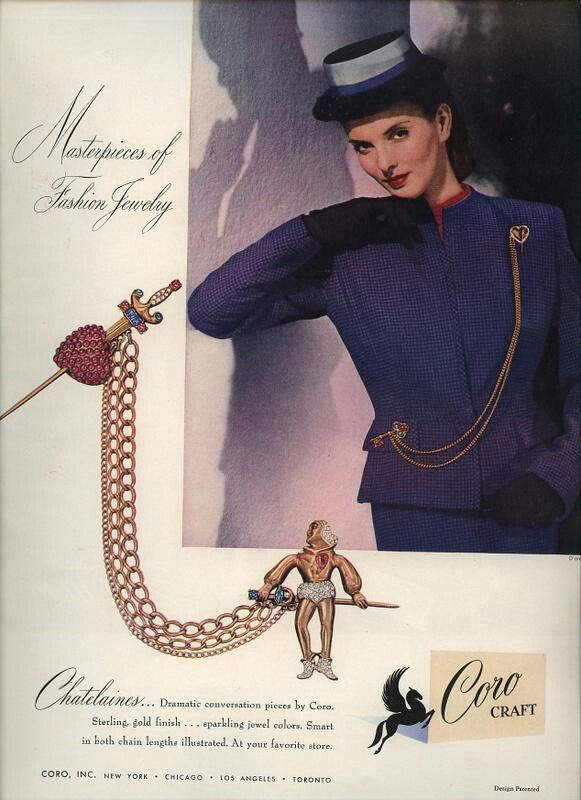
Visionary designers such as Paul Poiret, followed closely by Coco Chanel and Elsa Schiaparelli, embraced costume jewellery not as imitation, but as modern fashion in its own right. Among the manufacturers who defined this era, Coro, founded in the late 1920s and named after its founders Cohn and Rosenberger, remains one of my personal favourites, producing everything from exquisite Coro Craft pieces to affordable designs sold for mere dimes, proving that style, ingenuity, and beauty were no longer reserved for the elite.
1920s Brooch Style: Geometry, Modernity, and Art Deco Glamour
The popularity of the costume brooch began to grow in the early 20th century, when jewellery design became more accessible to everyday women. Prior to this shift, ornate adornment was largely reserved for the wealthy, but designers found ways to translate the beauty of fine jewellery into wearable, affordable forms without sacrificing artistry.
By the 1920s, the brooch had become an essential fashion accessory. Designers, many trained in traditional fine jewellery, used innovative materials such as glass, enamel, rhinestones, and plated metals to create pieces that felt luxurious yet attainable. These were not imitations; they were creative expressions in their own right. The craftsmanship, even in non-precious materials, was often exceptional, a real work of art.2
A 1920s brooch often features sharp angles, strong contrasts, and polished surfaces. When I style a 1920s brooch today, I love placing it slightly off-centre, perhaps on a lapel or pinned to a hat, to echo that sense of movement and modernity, and a bit of drama.
In a nutshell, the 1920s jewellery mirrored the energy of the Jazz Age, sleek, architectural, and unapologetically bold. Brooches from this era often feature:
- Geometric shapes
- Strong symmetry
- Contrasting colors
- Glass stones and early rhinestones
- Influences from Cubism and Art Deco design
1930s Brooches: Romance, Movement, and Imagination
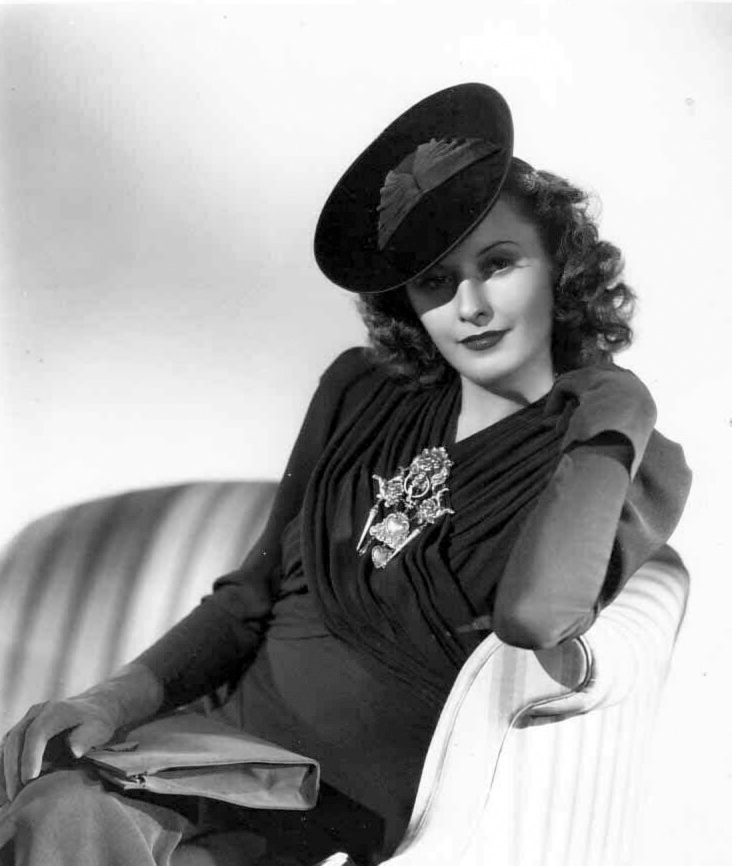
By the 1930s, fashion softened, and so did the brooch. Designs became more fluid, romantic, and expressive. Nature took centre stage, with motifs like birds, florals, my favourite bows, and whimsical figures becoming increasingly popular.
This era also embraced colourful enamelling and dimensional designs, giving the brooch a painterly quality. When worn on structured tailoring, such as my 1940s Betty Rose suit, a 1930s brooch adds a bit of va-va-voom. It softens the silhouette while maintaining elegance, making it one of my favourite decades to style.
1940s Brooches: Strength, Symbolism, and Structure
The 1940s were a decade shaped by rationing, resilience, and remarkable ingenuity, and the brooch rose to the occasion as one of the most expressive accessories of the era. Fashion became purposeful, and jewellery followed suit, quite literally. Brooches grew larger, bolder, and more sculptural, designed to hold their own against structured tailoring and strong silhouettes. Think sweeping bows, stylised florals, radiant sunbursts, and confident curves that mirrored the determined spirit of the women who wore them.
Because wartime restrictions redirected many base metals toward the war effort, designers turned to alternatives such as sterling silver, giving the 1940s brooch a satisfying weight and presence. These same restrictions shaped clothing just as dramatically, something I’ve explored in depth in my article on the Utility Clothing Scheme in Britain and my own 1940s CC41 collection, as well as in a detailed piece on 1940s fashion more broadly, which you may enjoy if this era fascinates you as much as it does me. Far from limiting creativity, these constraints encouraged designers and dressers alike to be resourceful, thoughtful, and inventive.
The hardships of the decade also sparked a delightful counter-response in the form of playful novelty jewellery, and the brooch became the perfect canvas for wit and whimsy. Animals, cheerful figures, and symbolic motifs appeared in pin form, offering small moments of joy during uncertain times. One of my most treasured examples, the horse brooch I’m wearing in the photographs, belonged to my late mother-in-law, and it perfectly embodies this spirit. It’s charming, sentimental, and quietly rebellious in its cheerfulness.
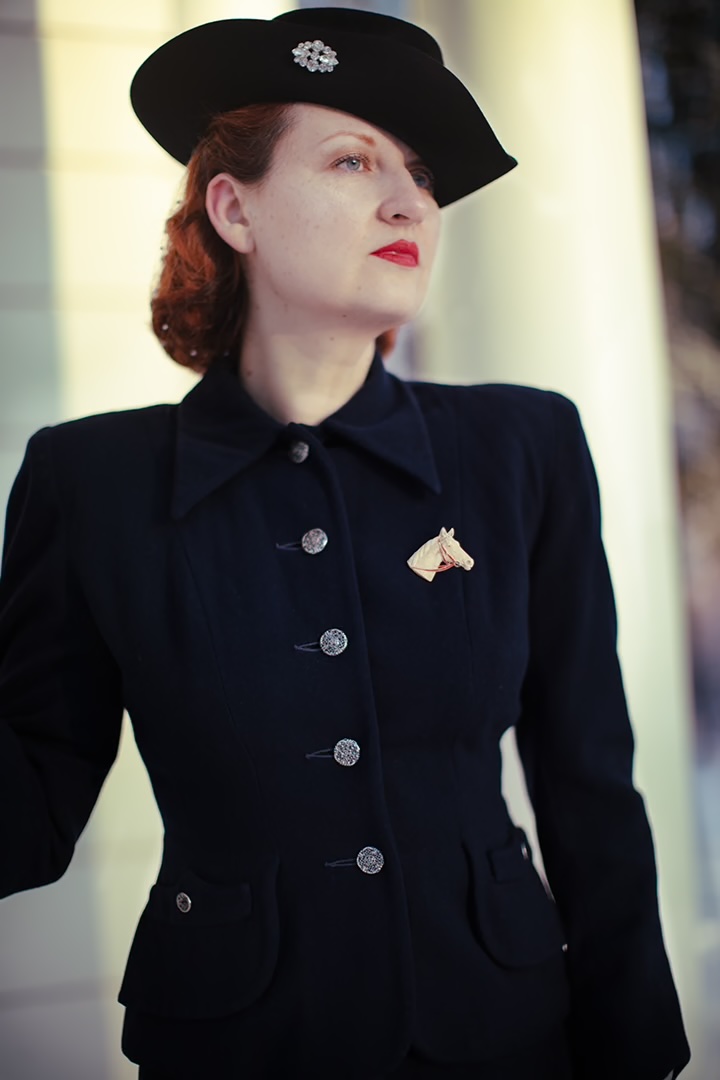
Patriotism and personal meaning were deeply woven into 1940s brooch design. Many women wore brooches as tokens of love, loyalty, and hope, transforming them into keepsakes rather than mere accessories. A 1940s brooch was rarely chosen at random; it was worn with intention, layered with emotion, and often kept for life.
When I pinned a sparkling 1940s brooch to my fedora for this shoot, the effect was immediate and wonderfully cinematic, confident, commanding, and unapologetically bold. It’s a reminder that a brooch doesn’t whisper; it speaks. And in the 1940s, women understood that perfectly, using jewellery not only to adorn themselves, but to express resilience, wit, and unmistakable style.
The 1950s Brooch: Glamour Returns
By the 1950s, fashion had finally exhaled. The war was over, austerity had loosened its grip, and the brooch once again had permission to be purely delightful. This was the decade of polished femininity, and brooches reflected that mood beautifully, refined rather than severe, luminous rather than symbolic. Floral sprays flourished, gold-toned metal warmed the complexion, and rhinestones were arranged with a wayward confidence that felt celebratory without ever trying too hard.
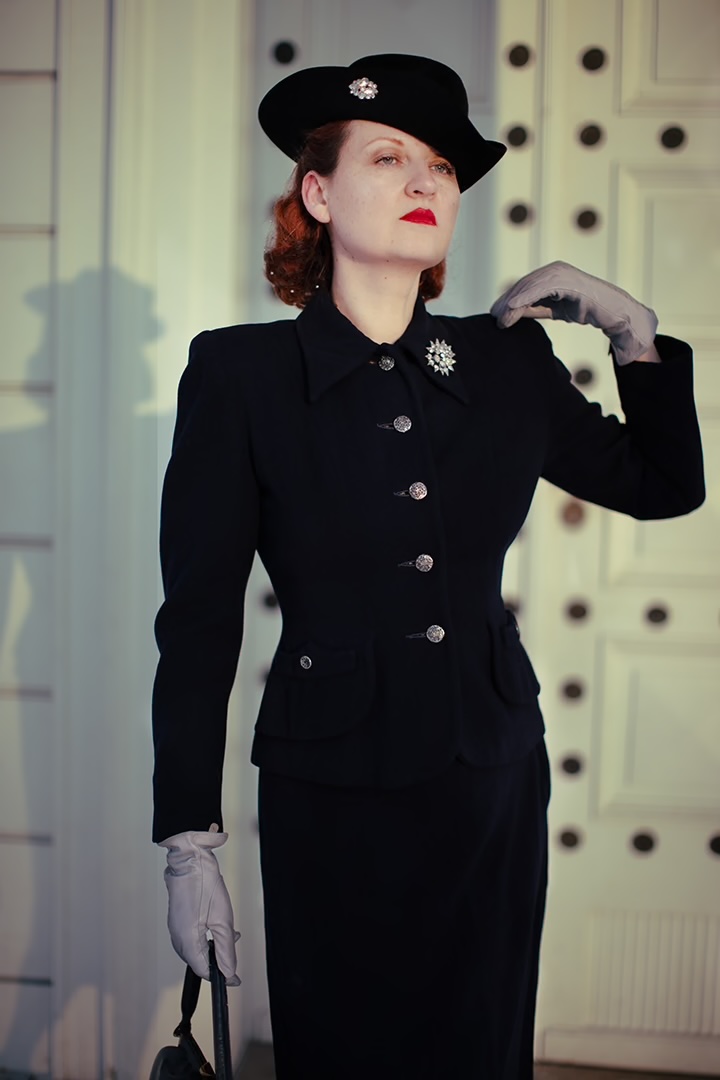
What I adore about a 1950s brooch is its impeccable manners. These pieces know exactly how to behave: they catch the light, flatter the silhouette, and quietly announce that their wearer understands the art of glamour. Many of the finest examples, now housed in institutions like the Met and the Victoria and Albert Museum, reveal just how skilled designers were at creating drama through scale, sparkle, and balance.
I’ll admit it freely, I have a very large collection of gloriously oversized, sparkling 1950s brooches. They are utterly addictive. Part of the joy lies in the fact that they are costume jewellery and therefore still relatively inexpensive, which makes collecting them feel more like a pleasure than an indulgence. One leads to another, and before you know it, you’ve justified a drawer dedicated entirely to rhinestones.
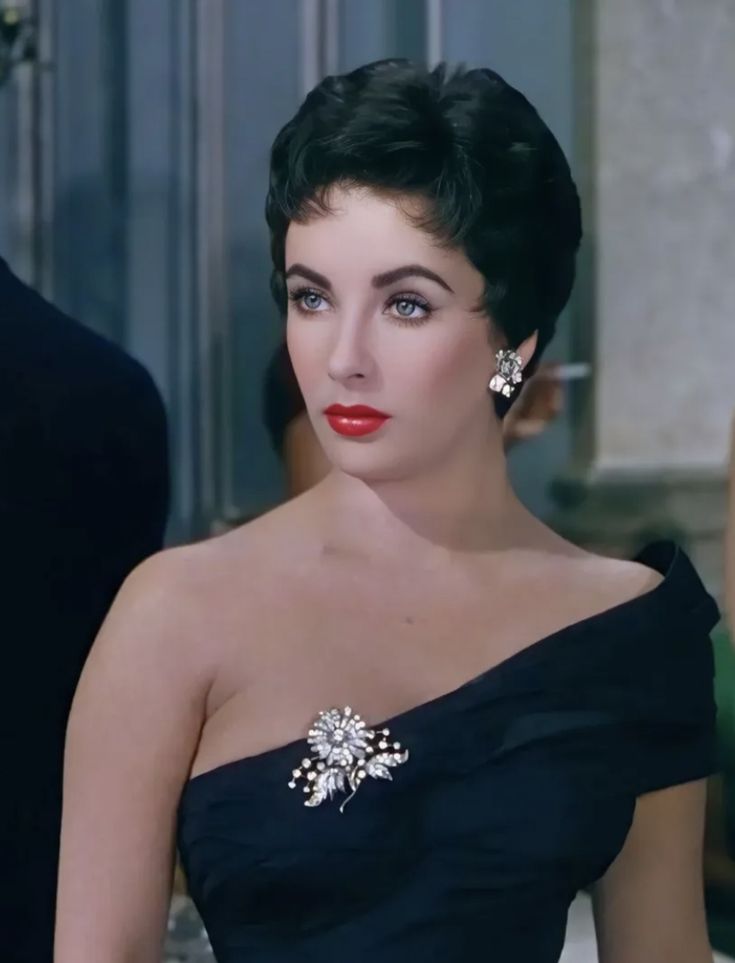
If you’re wondering how to wear a vintage brooch from the 1950s, my advice is simple: let it shine. Pinned to the collar of a tailored jacket, it adds instant polish. At the shoulder or neckline, it softens structure with femininity. Even worn slightly off-centre, a 1950s brooch has an uncanny ability to look like it truly belongs there rather than being accidental, a skill many modern accessories have yet to master.
Collector’s Sidebar: How I Spot a Good 1950s Brooch
Collecting 1950s brooches is a slippery slope, and I say that with affection. When I’m hunting, whether on Etsy or wandering flea markets around the world, I look first for presence. A good 1950s brooch should feel slightly larger than life, with a confident scale that reflects the decade’s love of glamour. These pieces were designed to be seen, not whispered about. It was definitely the era for a maximalist.
Construction matters. I always turn a brooch over and check the setting: prong-set rhinestones rather than glued ones, a solid pin mechanism, and a reassuring weight in the hand. Gold-toned metal was common in the 1950s, often warm rather than brassy, and rhinestones should still have sparkle; dull stones usually mean moisture damage, which is difficult to revive.
Design is everything. I’m drawn to starbursts and flower motifs. Many excellent 1950s brooches are unsigned, and unless you are a hardcore collector looking for very specific brands and jewellery makers, that shouldn’t matter. It will also be much cheaper than a signed brooch.
Shopping online, particularly on Etsy, I study photographs obsessively and never shy away from asking sellers about condition, stone replacement, or repairs. At flea markets, I trust my instincts: if a brooch makes me smile immediately, and I can afford it, it usually deserves to come home with me. After all, the beauty of collecting costume jewellery is that it remains wonderfully approachable — and once you start, don’t be surprised if one brooch quickly turns into ten.
Betty Rose Suits: Quiet Power from the American Heartland
Some vintage labels shout. Betty Rose never had to.
When I recently purchased a dark navy 1940s Betty Rose suit, it immediately asserted itself as the main character of my wardrobe, and this post. Not through flamboyance, but through impeccable structure, weight, and restraint. This is the sort of suit that does not compete with its wearer. It supports her. And for anyone who loves accessorising with vintage brooches, navy wool of this depth is nothing short of perfection.
To understand why Betty Rose garments feel so assured, we have to return to their origins.
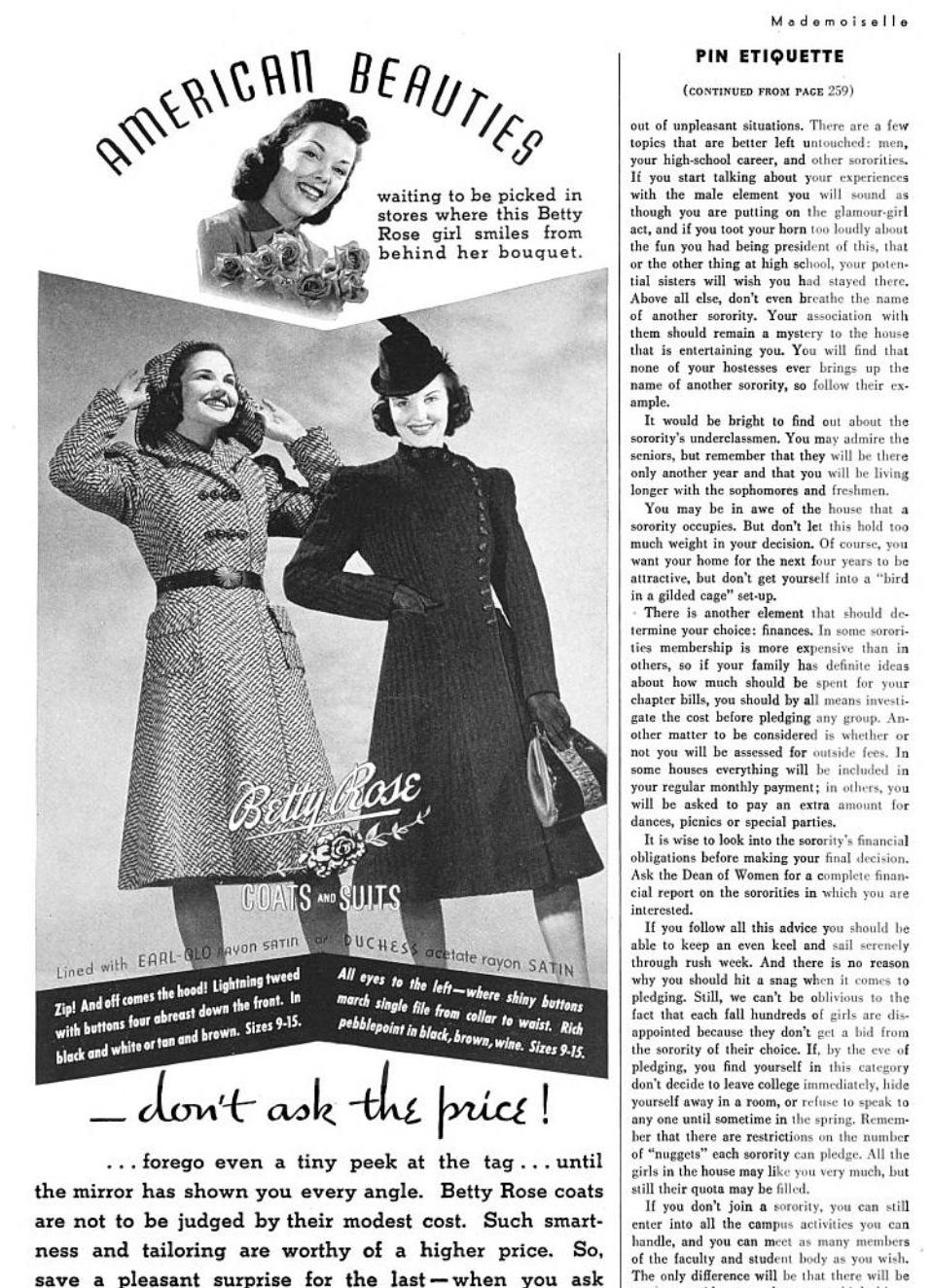
The Betty Rose Suits & Coats label was trademarked in 1926 by the Stern Slegman Prins Company, a Kansas City-based manufacturer founded by Ferdinand Stern, Saul Slegman, and Frank Prins. What began as a jobbing business evolved into a full-scale manufacturing operation at a time when American ready-to-wear was becoming increasingly industrialised.
Kansas City may surprise some readers, but in the 1930s and 1940s, it was a genuine garment industry powerhouse, employing thousands of workers and supplying department stores across the country. Regional newspapers and trade publications of the era frequently highlighted Midwestern manufacturers for their efficiency, quality control, and ability to keep production domestic during economically volatile decades.
Betty Rose suits and coats were designed for the working and social lives of real women. Women navigating offices, travel, wartime shortages, and post-war optimism. While national fashion editorials often focused on the Parisian influence, American labels like Betty Rose shaped how women actually dressed on a day-to-day basis. Their tailoring favoured strong shoulders, balanced proportions, and durable fabrics. Pieces meant to be worn, not merely admired.
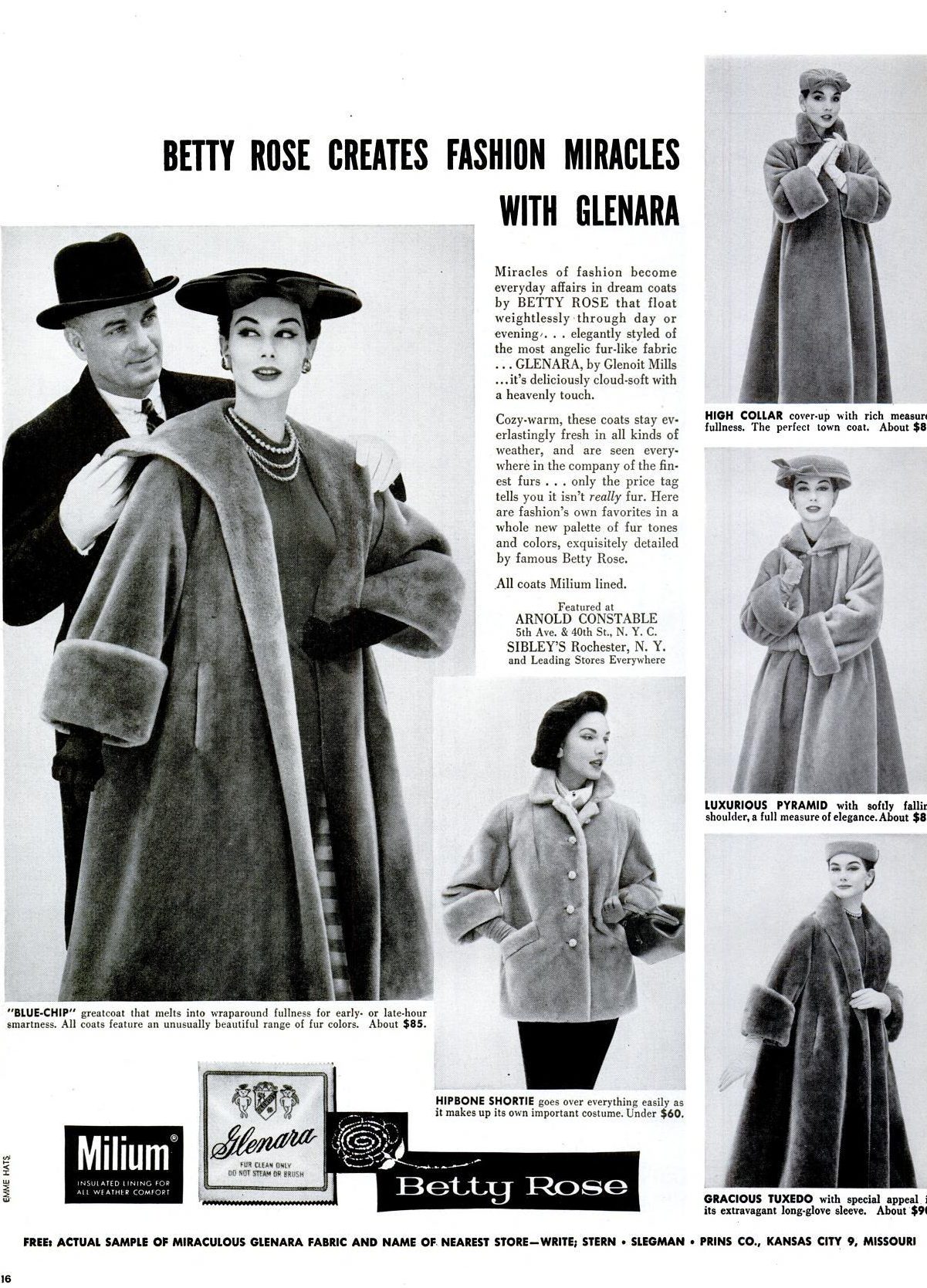
By the 1940s, Betty Rose suits reflected wartime practicality without sacrificing elegance. In the 1950s, the label softened in line with broader fashion trends, embracing femininity while retaining its hallmark construction. These garments were not trend-driven. They were investments.
My own Betty Rose suit embodies all of this history. Its clean lines create the ideal canvas for jewellery. A single floral brooch at the lapel. An Art Deco pin for contrast. Or a cluster of smaller costume pieces worn with intention. It is a reminder that suits were once a woman’s armour and can still be today.
For readers interested in the detailed business history, trademarks and pictures of the label through the decades, I recommend visiting Black Sheep’s Antiques website for a dedicated post on Betty Rose, where the label’s manufacturing legacy is explored in depth. This chapter is my love letter. The archive lives there.
Quietly powerful. Just like the suit itself.