What Women Wore For an Evening Out in the 1940s
1940s Evening Wear: What Women Wore

- 1940s Evening Wear in Hollywood
- 1940s Evening Blouse from a Film with Bette Davis
- The Reality of 1940s Evening Wear: What Women Actually Wore
- 1940s Suits, Separates and the Art of Looking Put Together in the Evening
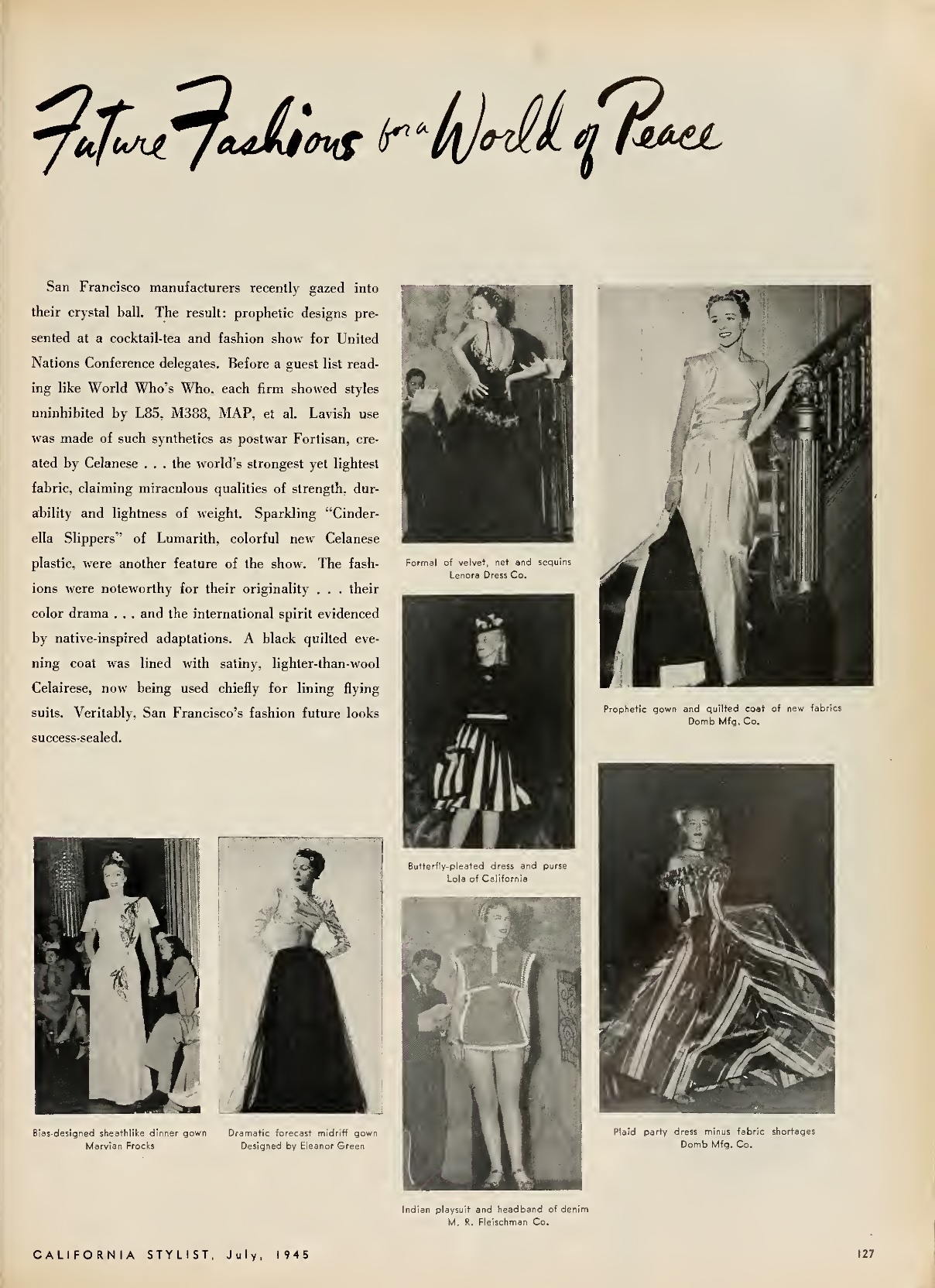
- Future Evening Fashions for a World of Peace
- My Original 1940s Outfit For an Evening Out
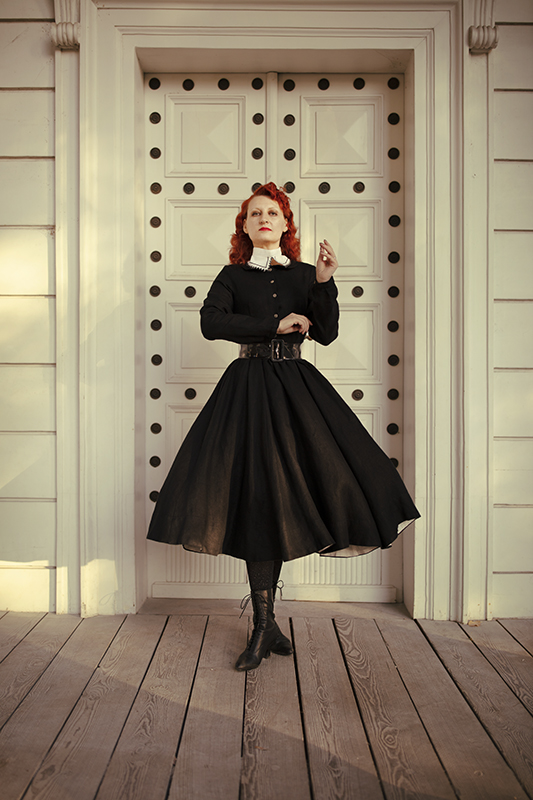
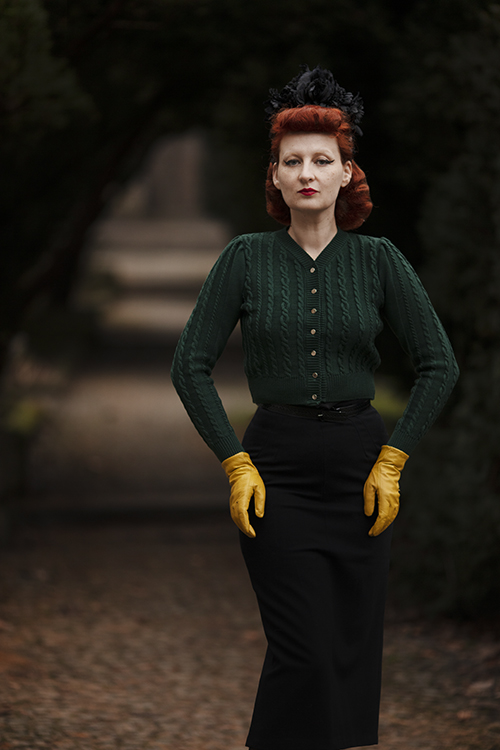
I’ve been wearing original 1940s clothing almost every day for more than twenty years. Thus far, I’ve studied and worn hundreds of garments from the decade. This article combines examples of 1940s evening wear in Hollywood, on and off the screen, as well as the reality for women in German occupied cities across Europe, and my own experience living in authentic 1940s clothing with one particular evening ensemble form that era.
When I think of 1940s evening wear, Hollywood films come immediately to mind, in particular my old time favourites; The Philadelphia Story (1940), Now Voyager (1942), Old Acquaintance (1943), Mildred Pierce (1945) and Du Barry Was a Lady (1943), depicting glamorous evening gowns created by the most brilliant costume designers like; Adrian, Edith Head, Milo Anderson or Travilla. And while these cinematic creations have shaped our perception of the era, they tell only the part of the story. For most women, in particular in Europe, dressing for an evening out during War World II was more understated affair, although based on documented interviews of women in the US who were old enough to partake in evening activities in the 1940s, everyone did their best to look good, even under the most challenging circumstances.
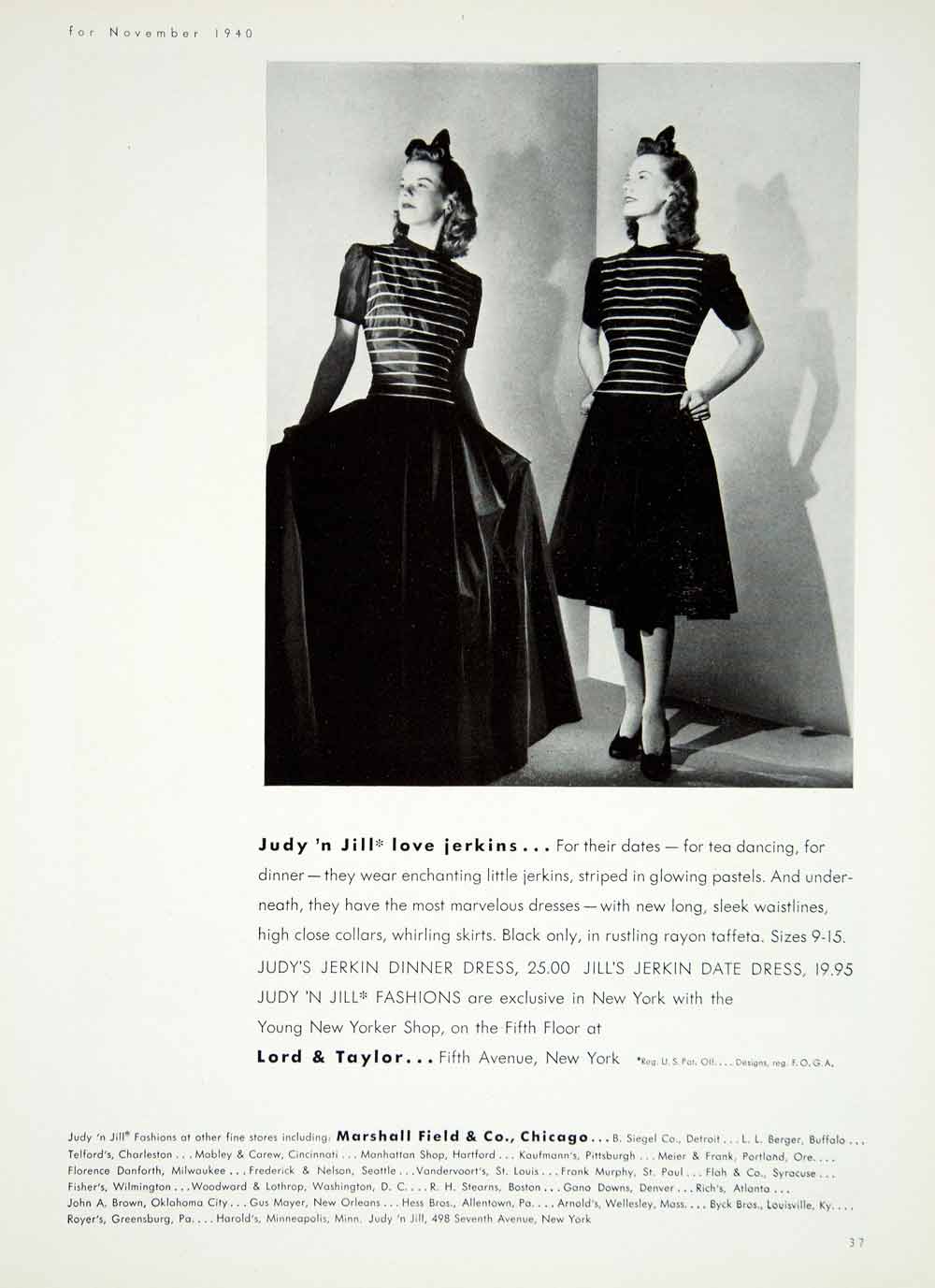
Whether meeting with friends for dinner, attending a theater or a soirée, elegance wasn’t defined by an elaborate pre-War evening gown. Instead, it was often achieved through beautifully coordinated separates that proved that sophistication didn’t depend on extravagance.
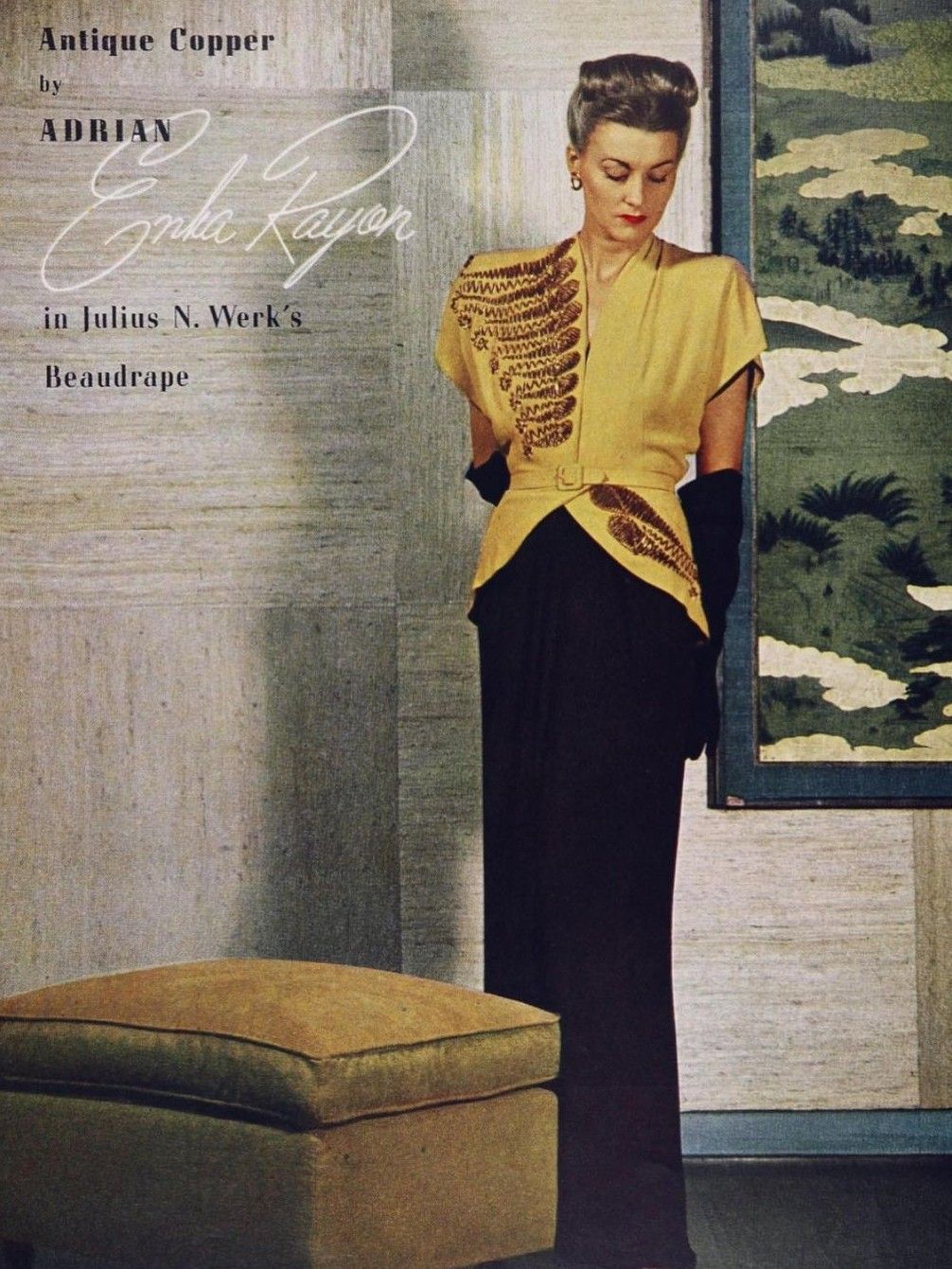
1940s Evening Wear in Hollywood
Old Hollywood did an exceptional job of letting us believe that the 1940s evening wear we saw on the silver screen was reflected in the evening wear of cinema-goers. And to a certain degree it was, because Hollywood film studios were selling or rather licensing, sketches of the costume designs from their films, and making a fortune by doing so. This is also why they insisted on their stars always appearing in public put together.
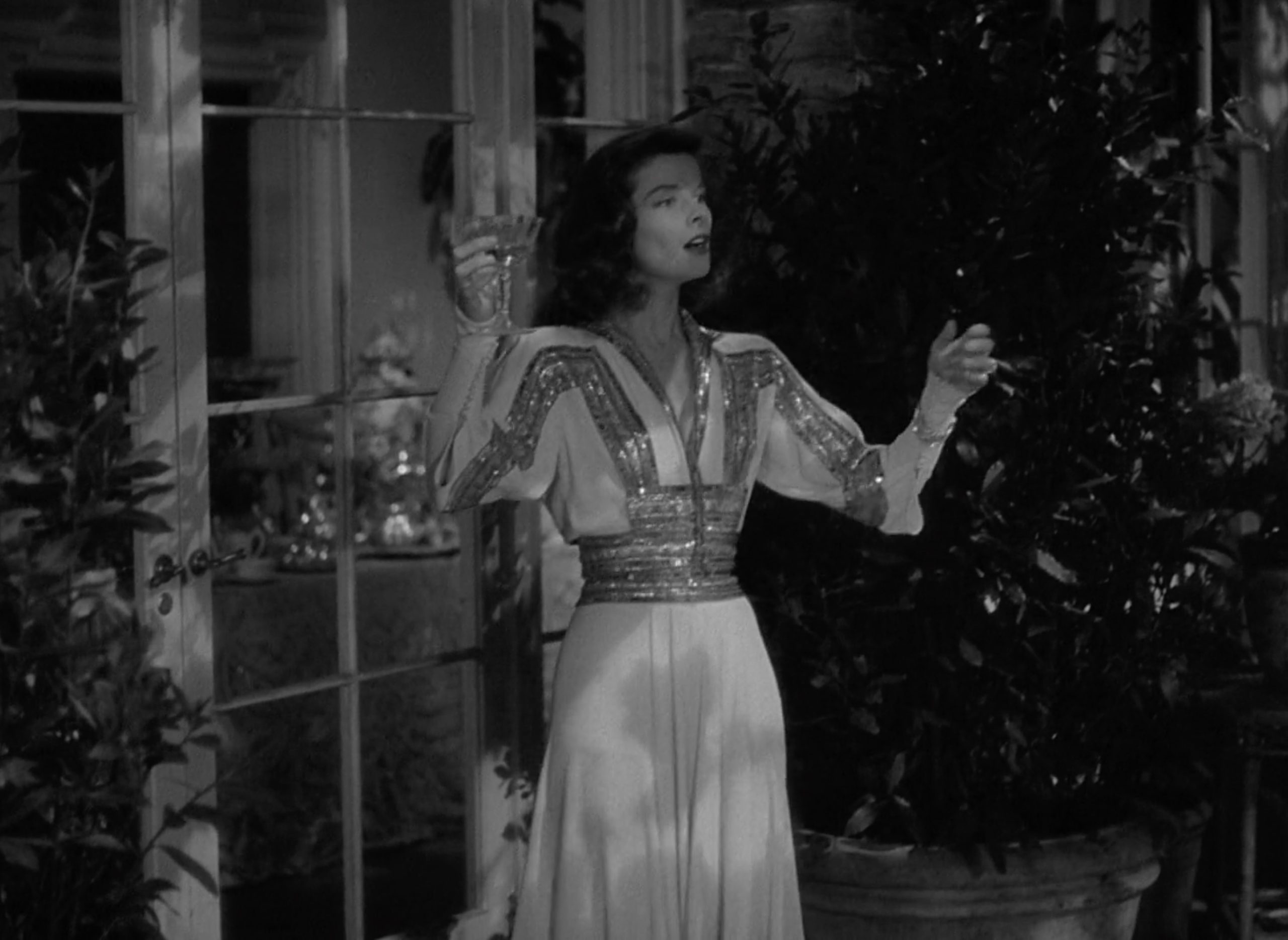
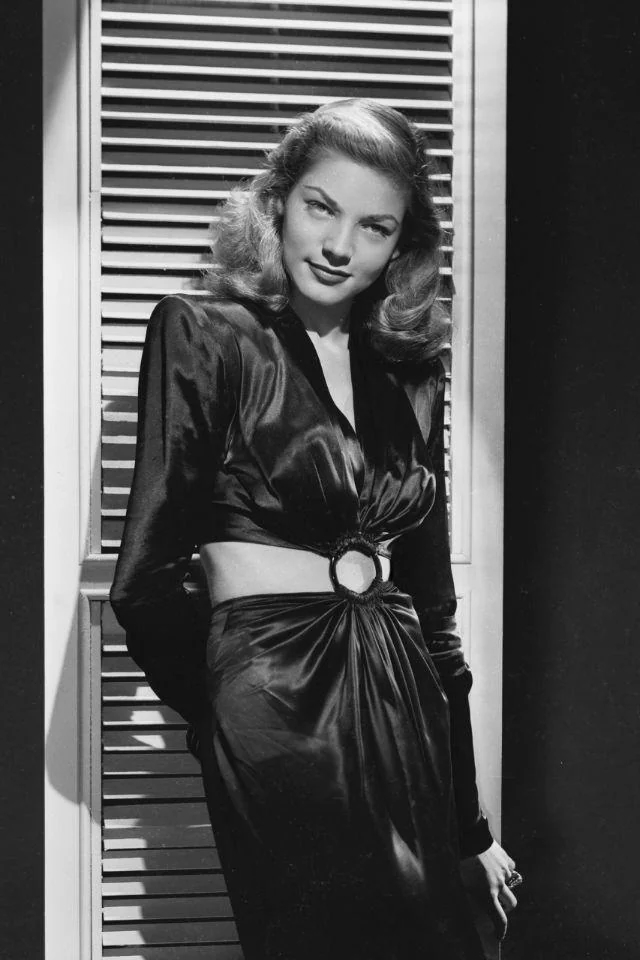
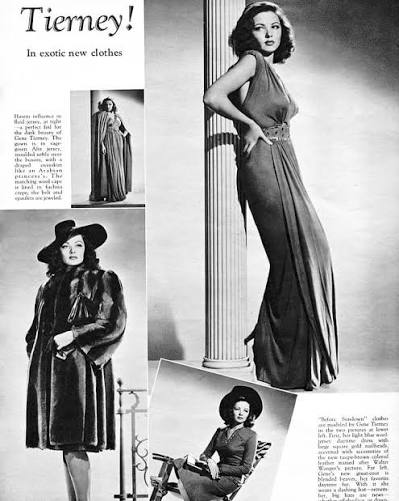
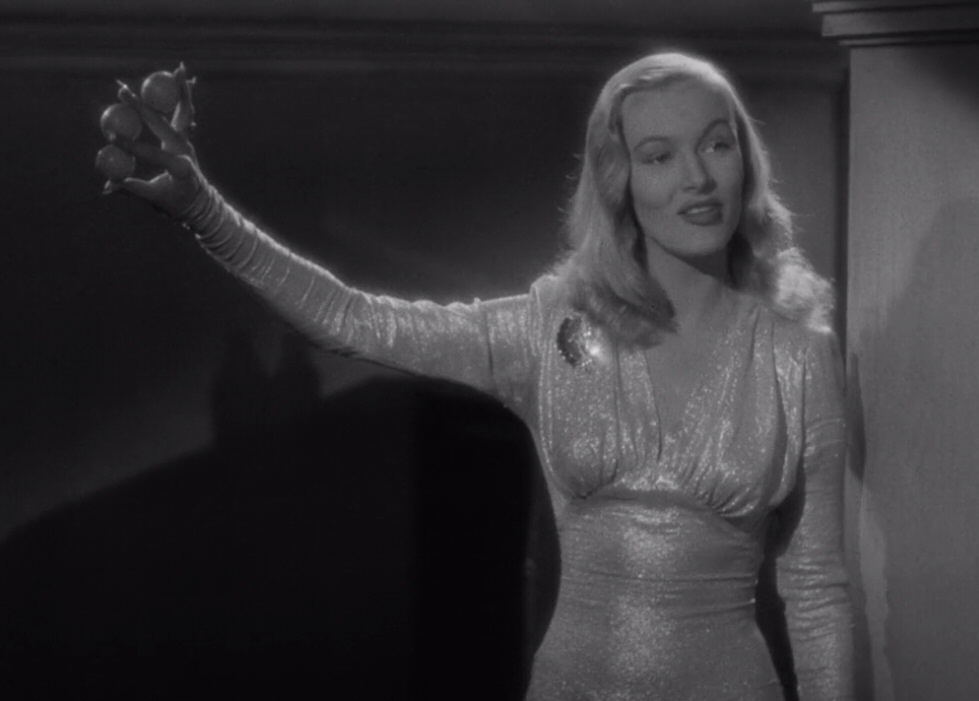
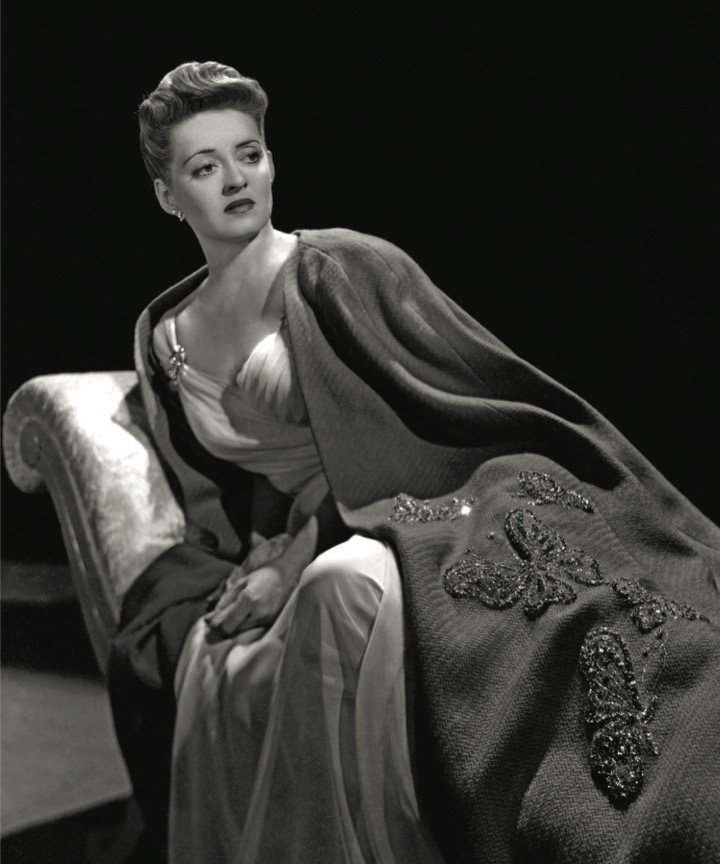
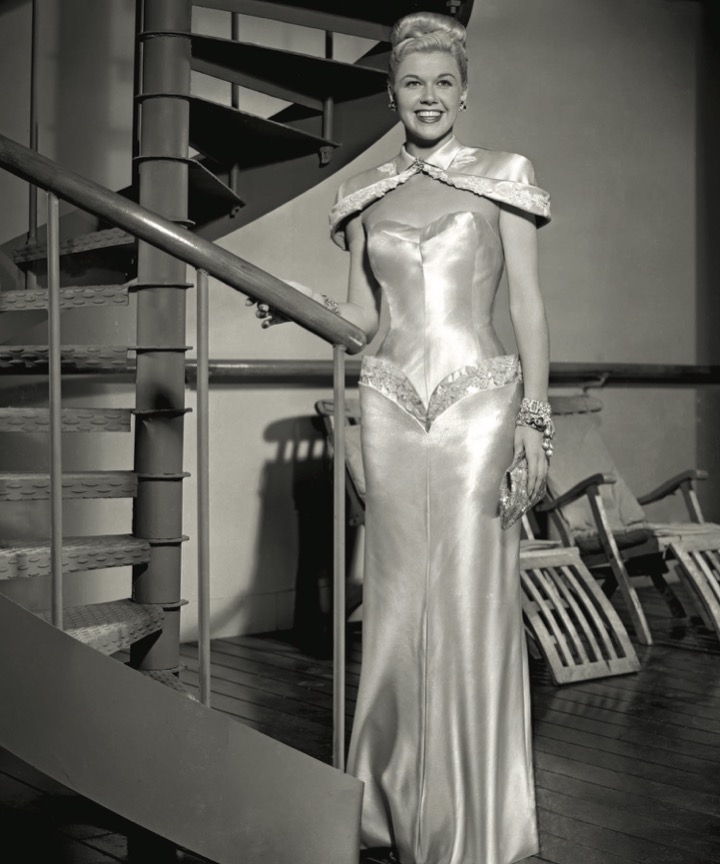
According to Constance Bennett, clothes help make the star!
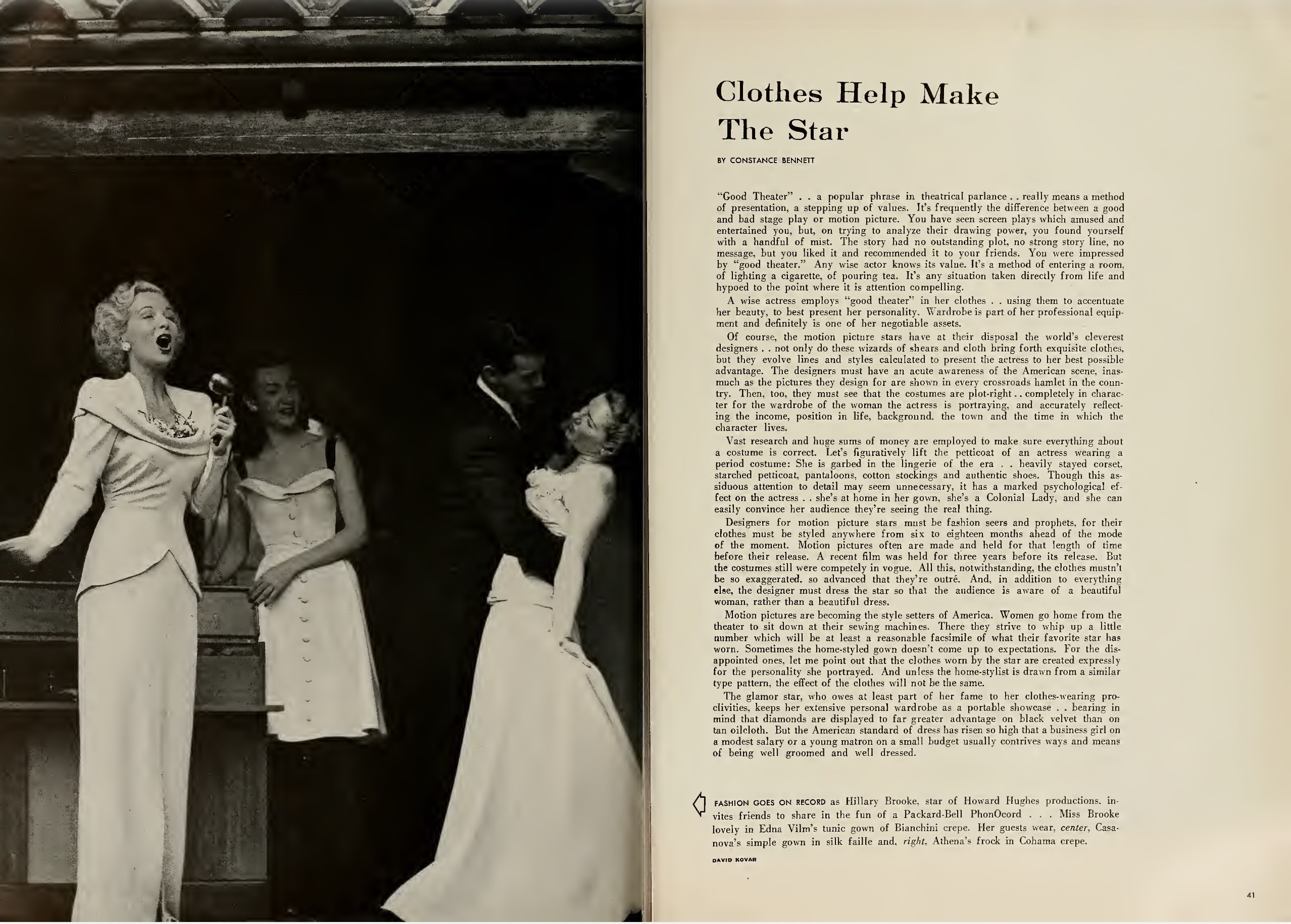
“Good Theater”. . a popular phrase in theatrical parlance. . really means a method of presentation. A wise actress employs “good theater” in her clothes. . using them to accentuate her beauty, to best present her personality. Wardrobe is part of her professional equipment and definitely is one of her negotiable assets. Of course, the motion picture stars have at their disposal the world’s cleverest designers. . not only do these wizards of shears and cloth bring forth exquisite clothes, but they evolve lines and styles calculated to present the actress to her best possible advantage. The designers must have an acute awareness of the American scene, in as much as the pictures they design for are shown in every crossroads hamlet in the country. Then, too, they must see that the costumes are plot-right. . completely in character for the wardrobe of the woman the actress is portraying, and accurately reflecting the income, position in life, background, the town and the time in which the character lives. Vast research and huge sums of money are employed to make sure everything about a costume is correct. Designers for motion picture stars must be fashion seers and prophets, for their clothes must be styled anywhere from six to eighteen months ahead of the mode of the moment. Motion pictures often are made and held for that length of time before their release. A recent film was held for three years before its release. But the costumes still were competely in vogue. All this, notwithstanding, the clothes mustn’t be so exaggerated, so advanced that they’re outre. And, in addition to everything else, the designer must dress the star so that the audience is aware of a beautiful woman, rather than a beautiful dress. Motion pictures are becoming the style setters of America. Women go home from the theater to sit down at their sewing machines. There they strive to whip up a little number which will be at least a reasonable facsimile of what their favorite star has worn. Sometimes the home-styled gown doesn’t come up to expectations. For the disappointed ones, let me point out that the clothes worn by the star are created expressly for the personality she portrayed. And unless the home-stylist is drawn from a similar type pattern, the effect of the clothes will not be the same. The glamor star, who owes at least part of her fame to her clothes-wearing proclivities, keeps her extensive personal wardrobe as a portable showcase. . bearing in mind that diamonds are displayed to far greater advantage on black velvet than on tan oilcloth. But the American standard of dress has risen so high that a business girl on a modest salary or a young matron on a small budget usually contrives ways and means of being well groomed and well dressed.
Californian, 1947, Clothes Help Make The Star, by Constance Bennett
Fabulous Vintage Evening Gowns I found on Etsy
Disclosure: This post contains affiliate links, which means I may earn a small commission if you purchase a product through the links in this post. This commission helps to keep my website alive, and for that, I am grateful to you!
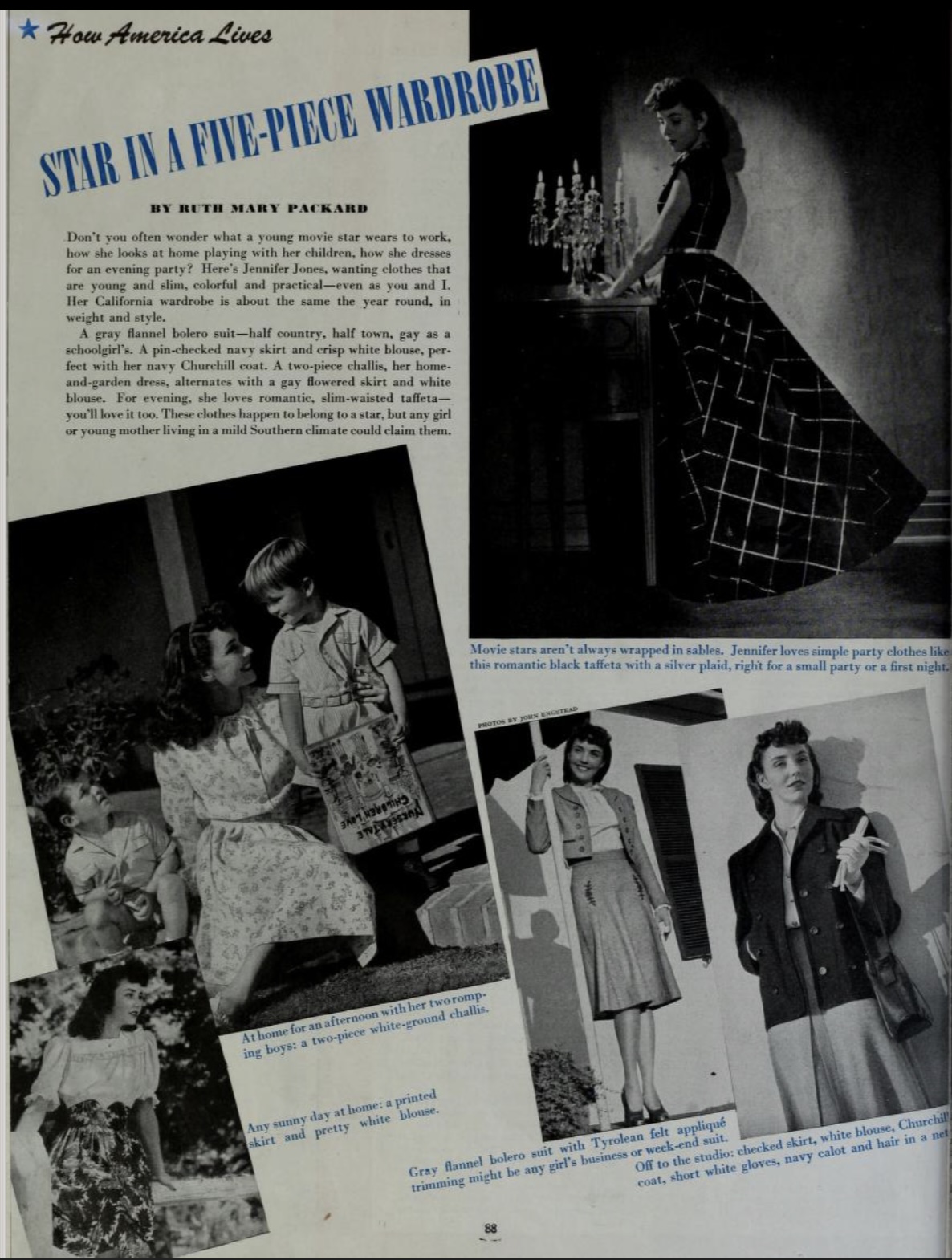
How America Lives in the 1940s According to a Movie Star
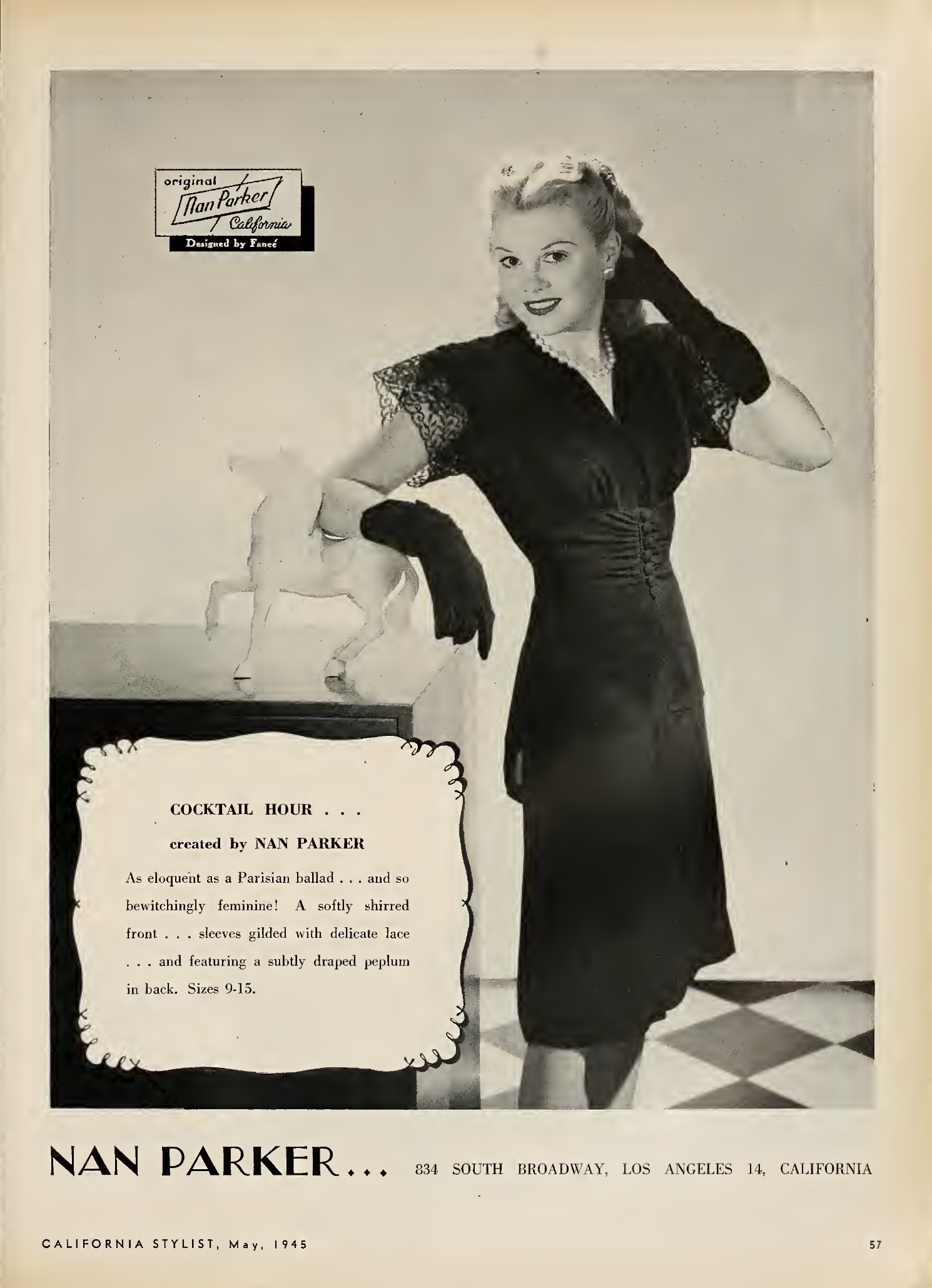
Don’t you often wonder what a young movie star wears to work, how she looks ate home playing with her children, how she dresses for an evening party? Here’s Jennifer Jones, wanting clothes that are young and slim, colorful and practical—even as you and I. Her California wardrobe is about the same the year round, in weight and style. (…) For and evening, she loves romantic, slim-waisted taffeta—you’ll love it too. The clothes happen to belong to a star, but any girl or young mother living in a mild Southern climate could claim them. Movie stars aren’t always wrapped in sables. Jennifer loves simple party clothes like this romantic black taffeta with a silver plaid, right for a small party or a first night.
1940s Evening Blouse from a Film with Bette Davis
I love Hollywood as much as anyone, but when I look at original 1940s clothing, worn by “real” women, the reality is much more interesting.

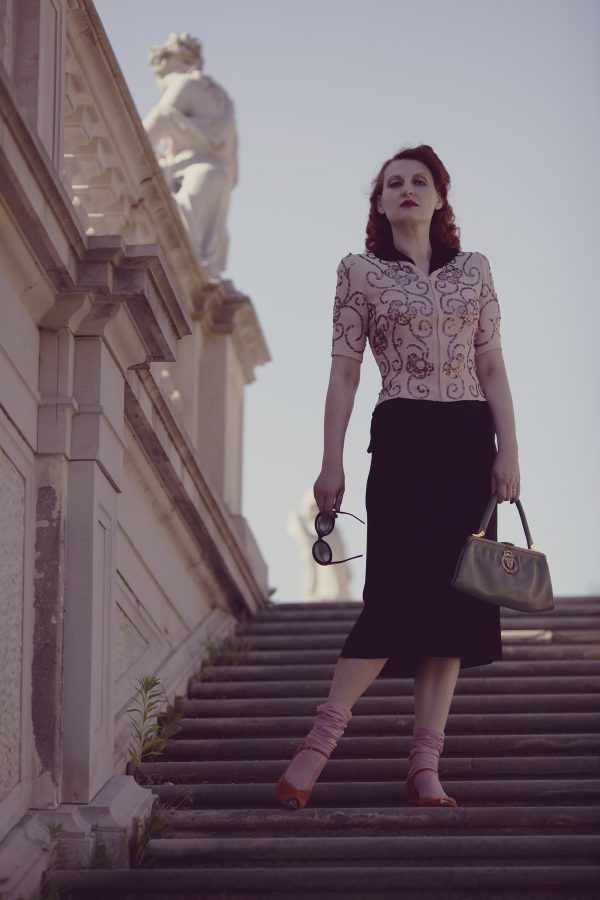
One of my favourite examples is Old Acquaintance (1943), starring the magnificent Bette Davis. It is exactly the sort of film that can make you believe that every woman in the 1940s spent her evenings looking utterly fabulous. And, rather wonderfully, I happen to own a piece of that Hollywood fantasy: a beautiful sequin top that appeared in the film.
I actually bought the blouse before I discovered its cinematic connection. It was already a spectacular late-1930s sequin piece, and then I discovered that it had appeared in Old Acquaintance. I mean, really. Sometimes the vintage Gods smile upon me. The blouse wasn’t worn by Bette Davis herself, but it can be seen in close proximity to her in the film. And suddenly this isn’t just a pretty vintage garment in my wardrobe. It is a surviving piece of the very world that helped create our idea of 1940s glamour.
But here is the important distinction: Hollywood did not invent evening glamour. It amplified it.
Women really did wear beautiful blouses, sparkling embellishments and carefully coordinated accessories when going out. What Hollywood gives us is the most theatrical version of this reality, presented under perfect lighting and worn by actresses whose job was to look fabulous.
The Reality of 1940s Evening Wear: What Women Actually Wore
One of the biggest misconceptions about wartime fashion is that fashion somehow stopped. It didn’t. Paris, traditionally the centre of Western (and beyond) fashion, was occupied, and this created an enormous opportunity for American designers to establish themselves. They began creating distinctly American styles and working within the restrictions imposed by the war. Retailers and manufacturers also had a problem: they still needed women to buy clothes. So advertising became particularly clever. Fashion marketing incorporated patriotism, wartime imagery and appeals to national duty while still giving women a reason to want something new. And this is perhaps the most important thing to remember when looking at a 1940s evening outfit. Even during wartime, women still wanted to look beautiful, and not just in America.
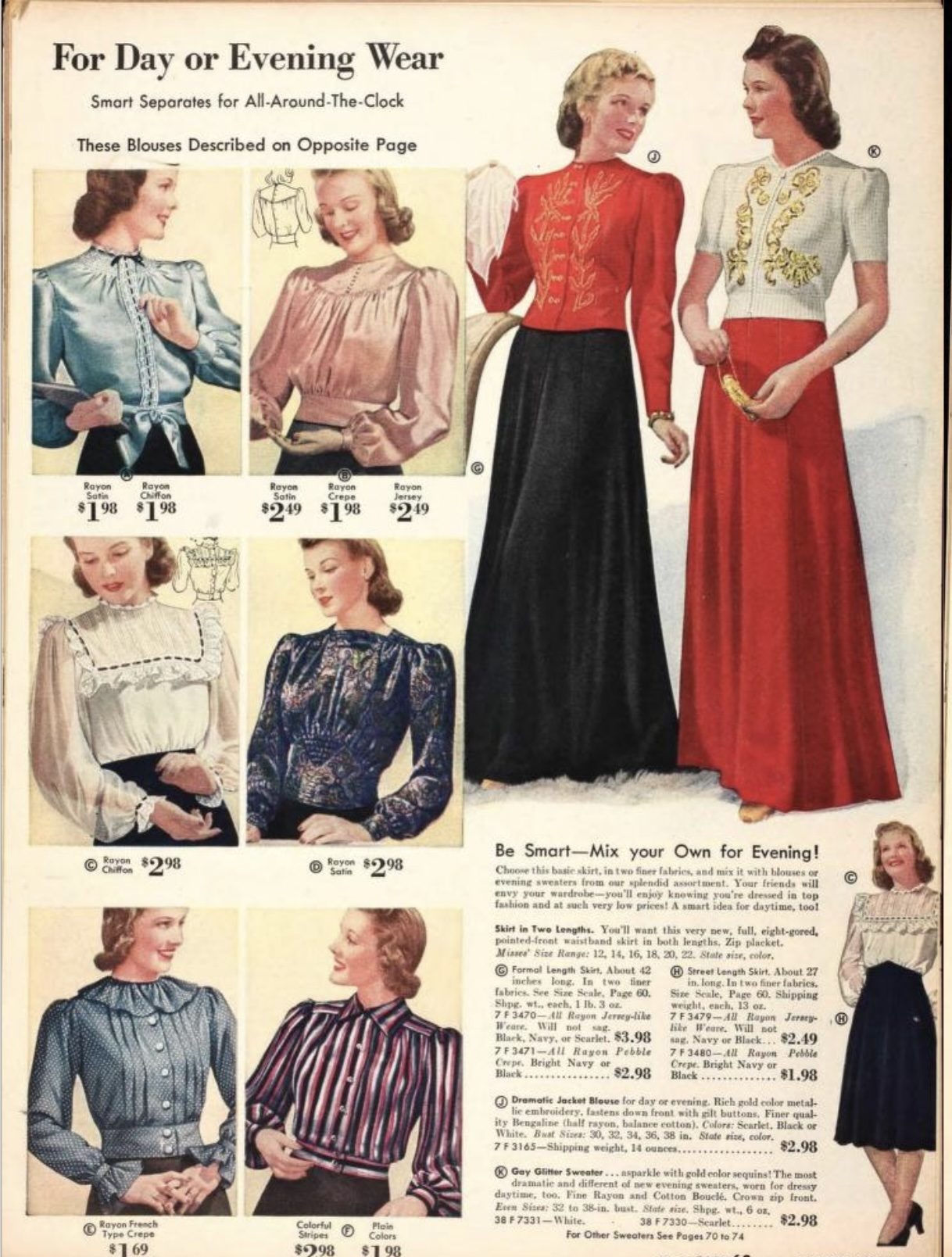
They still wanted a new dress. They still wanted a flattering silhouette. They still wanted to wear jewellery, a fabulous hat, gloves and heels. They still wanted to go out for the evening and feel glamorous. The war changed fashion, certainly. It changed the available materials, the silhouettes, the way clothes were marketed and the reasons women bought them. But it would be a mistake to think that that it eliminate fashion. If anything, it made the ingenuity of 1940s women even more impressive.
According to Jennifer M. Mower’s 2011 doctoral dissertation, “Pretty and Patriotic”: Women’s Consumption of Apparel During World War I, wartime fashion gradually became more streamlined. Skirts shortened to around the knee, shoulders broadened, and shoulder pads became increasingly important. The bias-cut styles so strongly associated with the 1930s became much less common.
What fascinates me is that this was not simply a case of women being told what they could and could not wear. In April 1942, the War Production Board introduced Limitation Order L-85 to conserve fabric and manufacturing resources for the war effort. The intention was essentially to freeze the pre-war silhouette and prevent fashion from becoming increasingly extravagant at a time when materials and manpower were desperately needed elsewhere.
But fashion, as usual, refused to behave quite so obediently.
The result was the silhouette we now think of as quintessentially wartime: slimmer skirts, knee-length or just below the knee, combined with fitted bodices and exaggerated shoulders. It was still recognisably an hourglass figure, but it looked sharper, more economical, and considerably more assertive than the softer late-1930s styles. And this is where I think the reality of wartime clothing becomes much more interesting than the idea of a government simply imposing a uniform style on women.
Mower’s research found that the regulations were surprisingly flexible. Existing garments did not always conform to L-85, and some even stretched its limits quite spectacularly. There were dresses with generous skirt sweeps, all-over pleating, bias-cut sections, wide pant legs, raglan sleeves and even leg-of-mutton sleeves. In other words, women’s clothing did not suddenly become joyless little fabric rationing exercises.
If you would like to learn about fashion in Britain during WWII under Austerity regulations, have a look at my article on the History of CC41 Utility Clothing Scheme.
1940s Suits, Separates and the Art of Looking Put Together in the Evening
One of my favourite things about 1940s clothing is how clever it could be. Separates became increasingly popular because they offered women considerably more versatility, and it’s one of the main reasons why I favour a 1940s skirt suit over any other piece of clothing when shopping for vintage. A jacket could be worn with one skirt one day and another the next, allowing a relatively small wardrobe to produce considerably more outfits.
Suits were particularly important in the 1940s. Short “bolero” jackets were popular, as were the jackets we now associate with the wartime military influence, including the so-called Eisenhower style. These jackets were often slightly bloused above the waist and drawn into a fitted belt, creating that very characteristic broad-shouldered, narrow-waisted silhouette.
And this is something I always like to point out when discussing 1940s fashion: the woman in a wartime suit was not necessarily dressed for battle, or even for work. The same strong shoulders, fitted waist and neat skirt could take her almost anywhere.
For an evening out, the suit could become surprisingly elegant. Add a hat, gloves, jewellery, carefully styled hair and a pair of heels, and suddenly a practical daytime silhouette had been transformed into something decidedly more glamorous, perfect for an evening out.
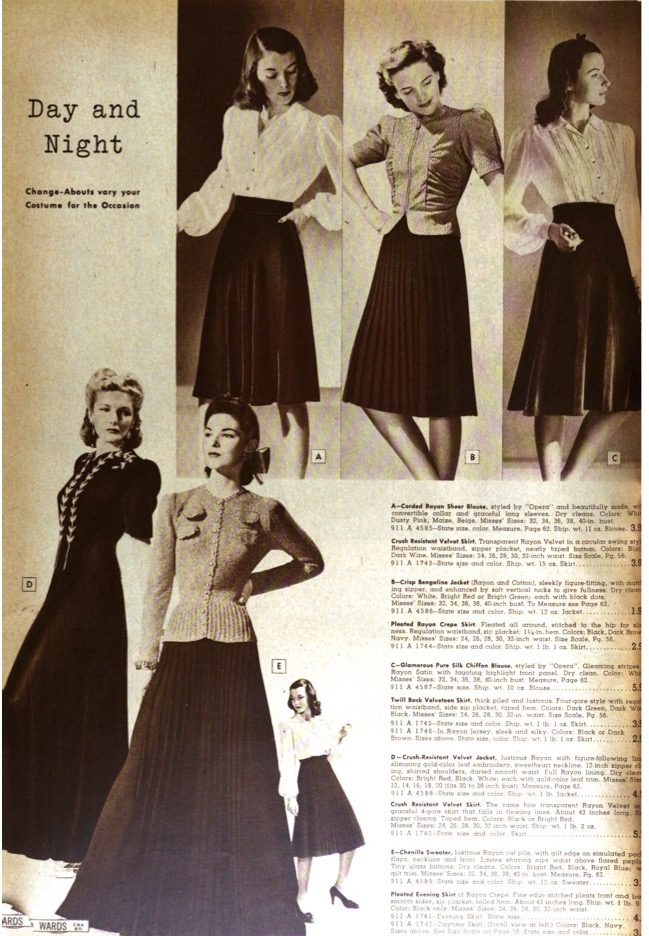
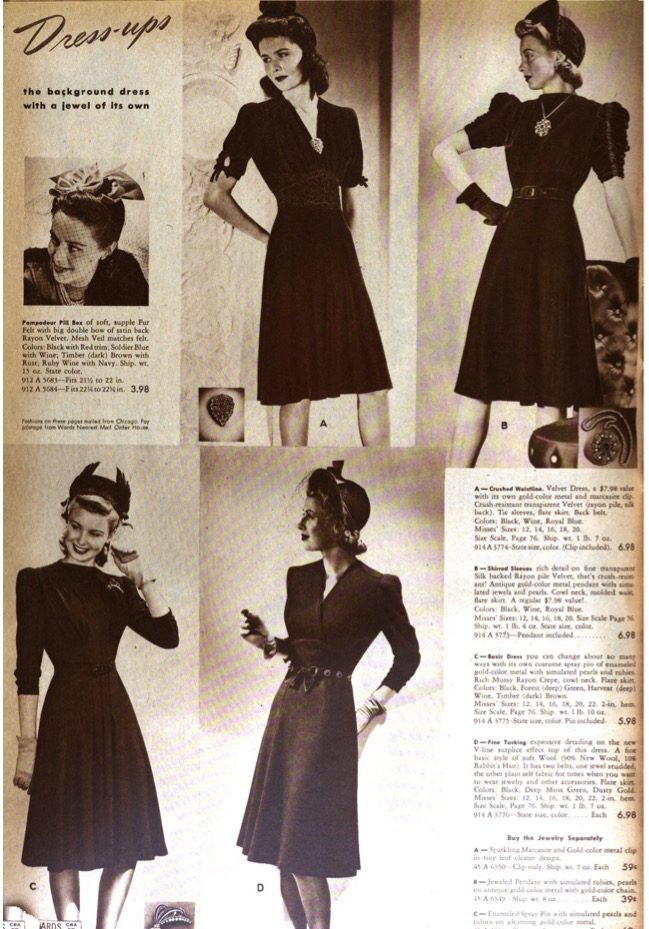
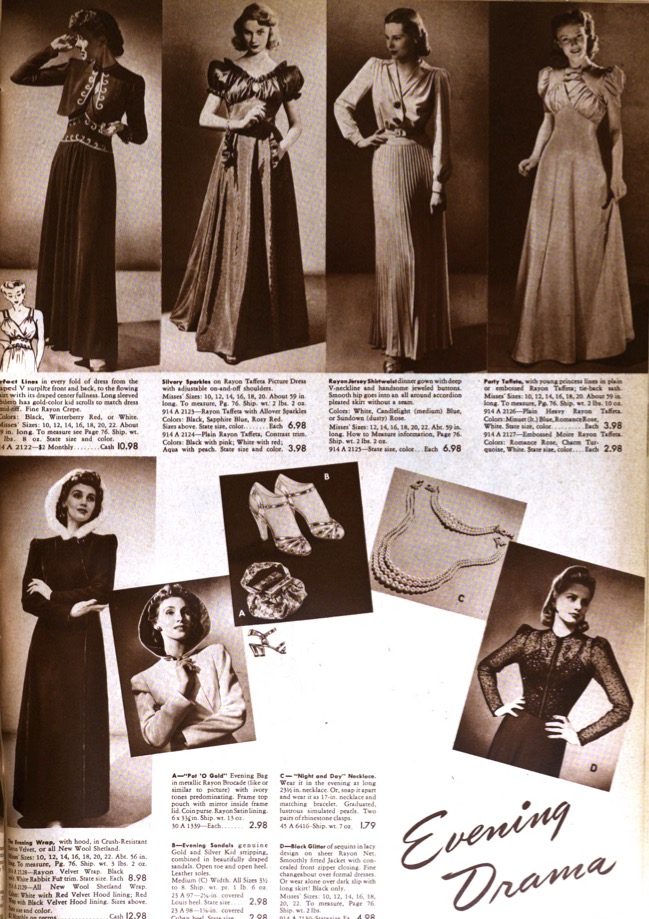
For a deeper look at the fashions women actually wore throughout the decade, read my Ultimate Guide to 1940s Women’s Fashion covering everything from everyday clothing on and off screen to accessories.
Future Evening Fashions for a World of Peace
San Francisco manufacturers recently gazed into their crystal ball. The result: prophetic designs presented at a cocktail-tea and fashion show for United Nations Conference delegates. Before a guest list reading like World Who’s Who, each firm showed styles uninhibited by L85, M388, MAP, et al. Lavish use was made of such synthetics as postwar Fortisan, created by Celanese…the world’s strongest yet lightest fabric, claiming miraculous qualities of strength, durability and lightnes in weight. Sparkling “Cinderella Slippers” of Lumarith, colorful bew Celanese plastic, were another feature of the show. The fashions were noteworthy for their originality… their solor drama…and the international spirit evidenced by native-inspires adaptations. A black quilted evening coat was lined with satiny, lighter-than-wool Celairese, now being used chiefly for lining flying suits. Veritably, San Francisco’s fashion future looks success-sealed.
California Stylist, July 1945
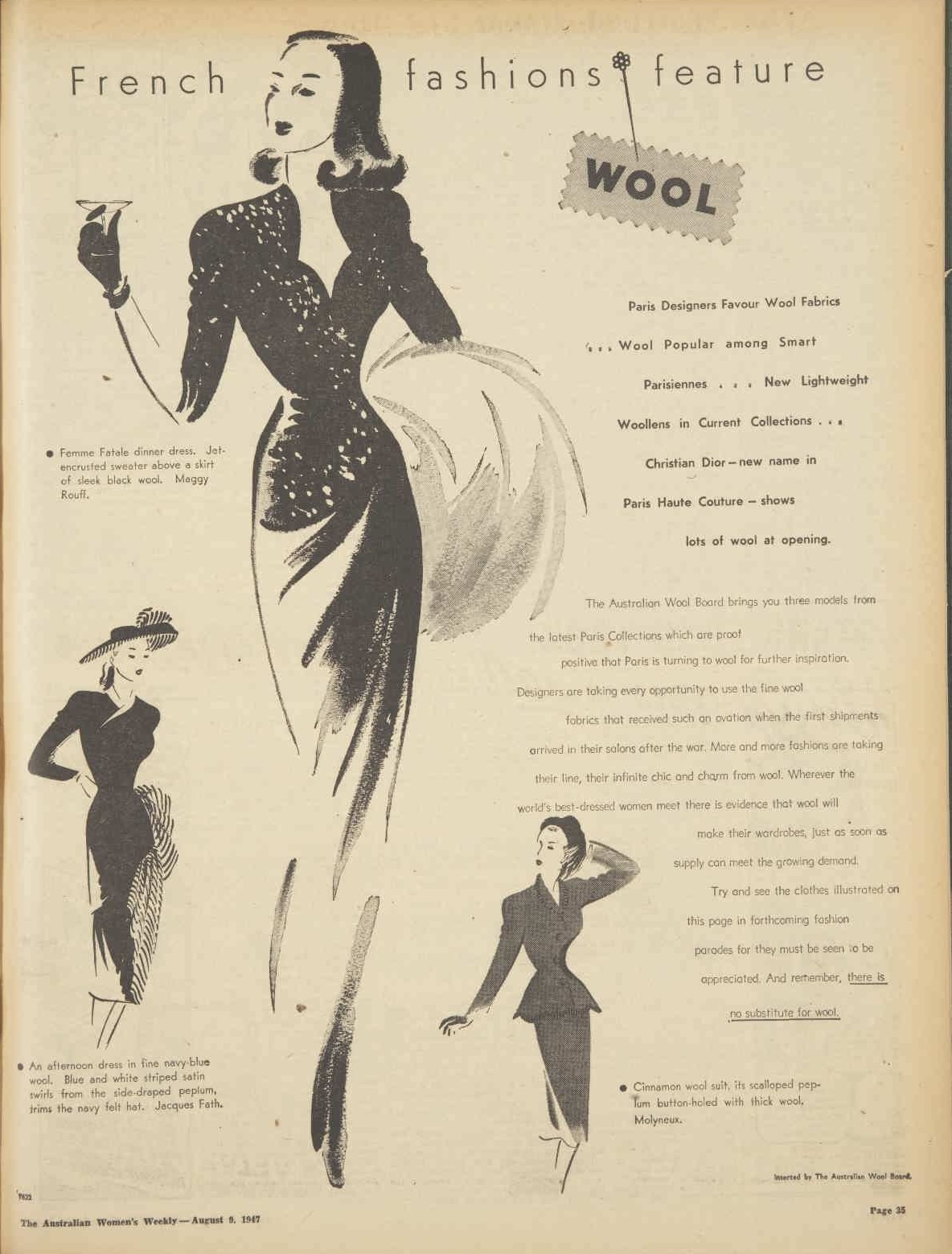
Femme Fatale dinner dress. Jet-encrusted sweater above a skirt of sleek black wool. Maggy Rouff.
Australian Women’s Weekle, August 9. 1947
Post-War fashion in America according to one of my favourite film costume designers, Adrian.
At a time when so many designers are reaching out for more and more yardage, dropping skirts with enthusiastic abandon. scurrying hither and there to achieve merely “change”…Adrian remains himself, thoroughly American and sure of the inherent good taste of the women whose clothes he creates. In his many years of designing wardrobes for motion picture stars and fashion-right women from all over the country, this authoritative couturier feels he has discovered certain inalienable truths about clothes, refuses to be diverted from proven fashion principles. And so in 1947 Adrian reaffirms his faith in the more flattering squared shoulders, not projected this year but still sharply Adrian…reaffirms his preference for the slim silhouette in street and afternoon clothes, even many suave evening gowns…shows clothes at no arbitrary length. his only rule being a by-eye guide to create a “pretty”appearance. Making a staunch stand for the right to be individual, free of dictatorial fashion mandates this famous American designer is convinced that women should wear what interests them, what is comfortable and right for the things they do.
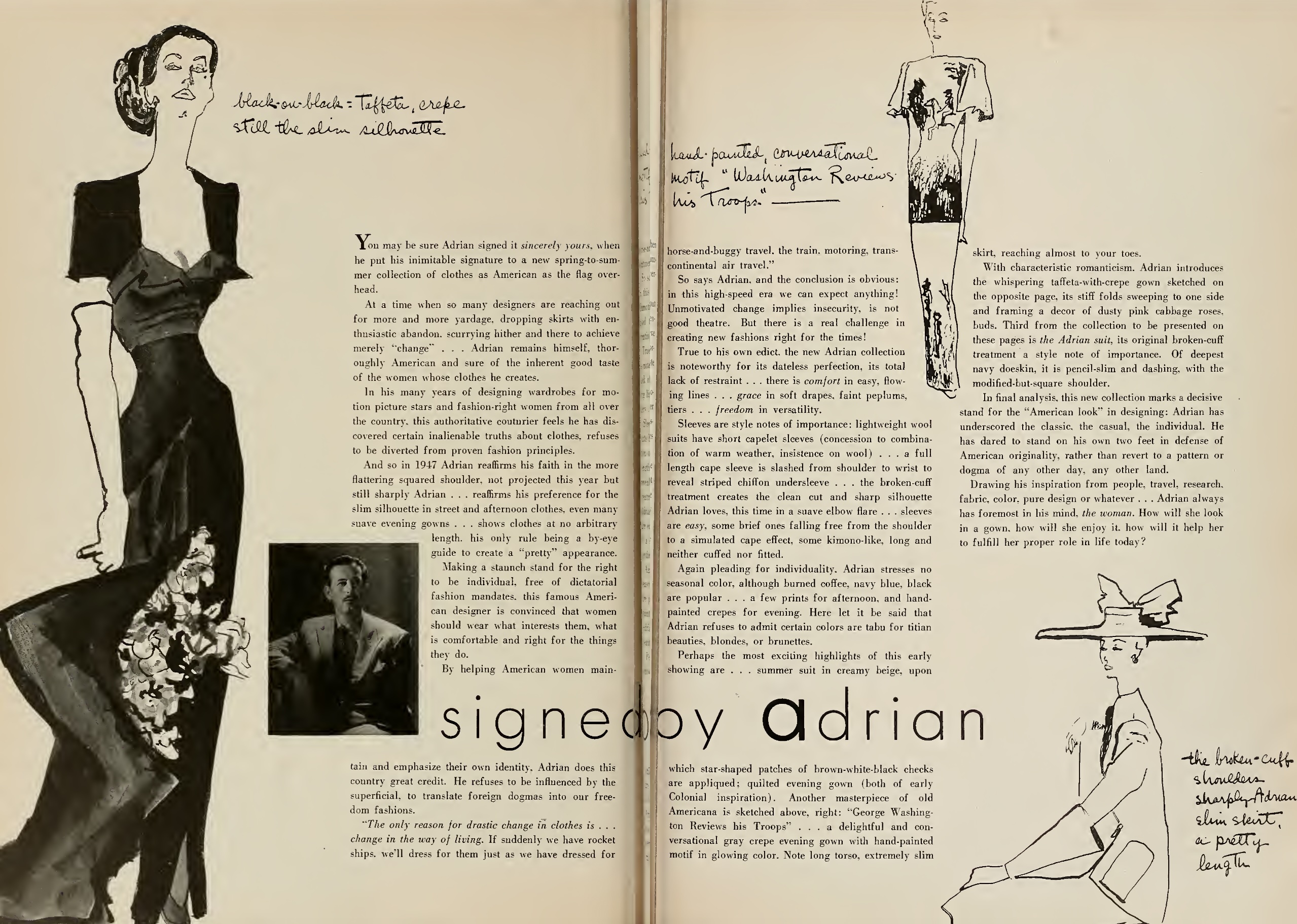
The only reason for drastic change in clothes is…change in the way of living. If suddenly we have rocket ships, we’ll dress for them just as we have dressed for horse and buggy travel. the train, motoring, trans-continental air travel.
Adrian, 1947
My Original 1940s Outfit For an Evening Out
Sometimes, when I’m surrounded by original vintage, I find myself wondering about the world these clothes were made for.
What did and evening out actually look like in the 1940s? Where would a woman, an American woman to be precise, have worn an evening ensemble like this? What would she have done with her hair for this particular look? And, perhaps most importantly, where would she have gone?
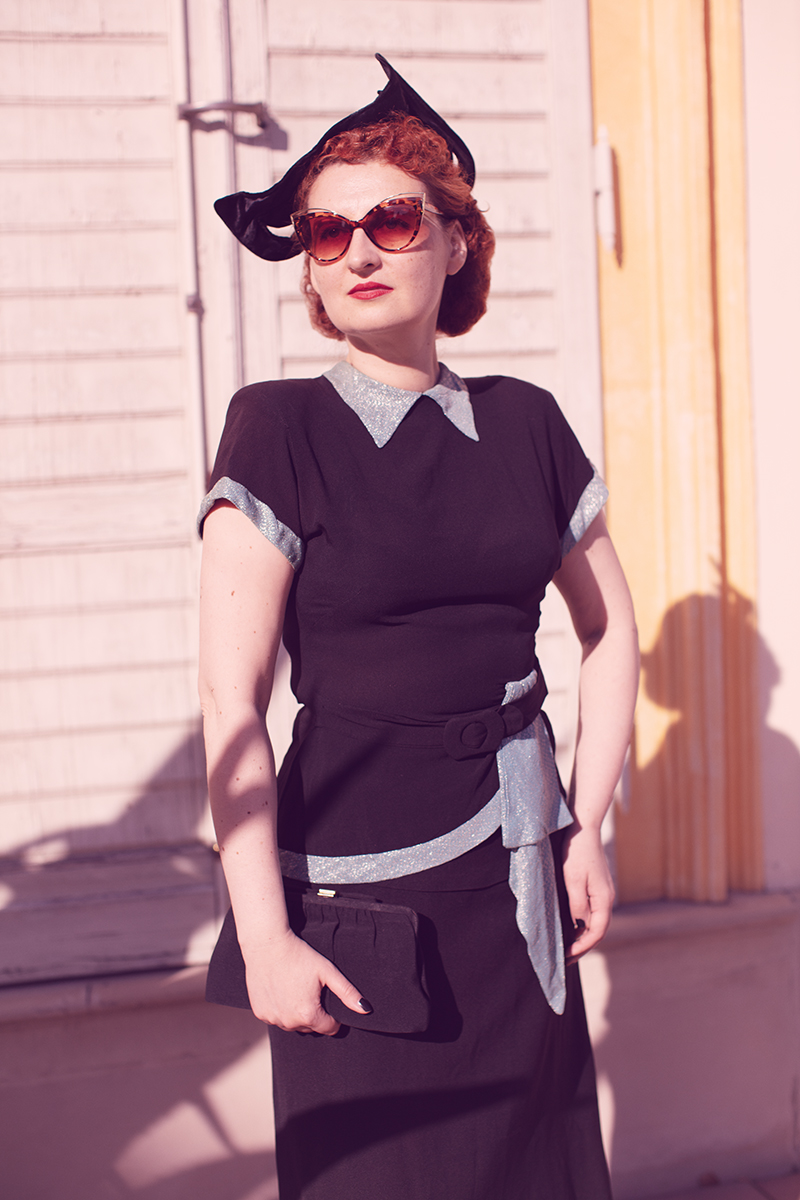
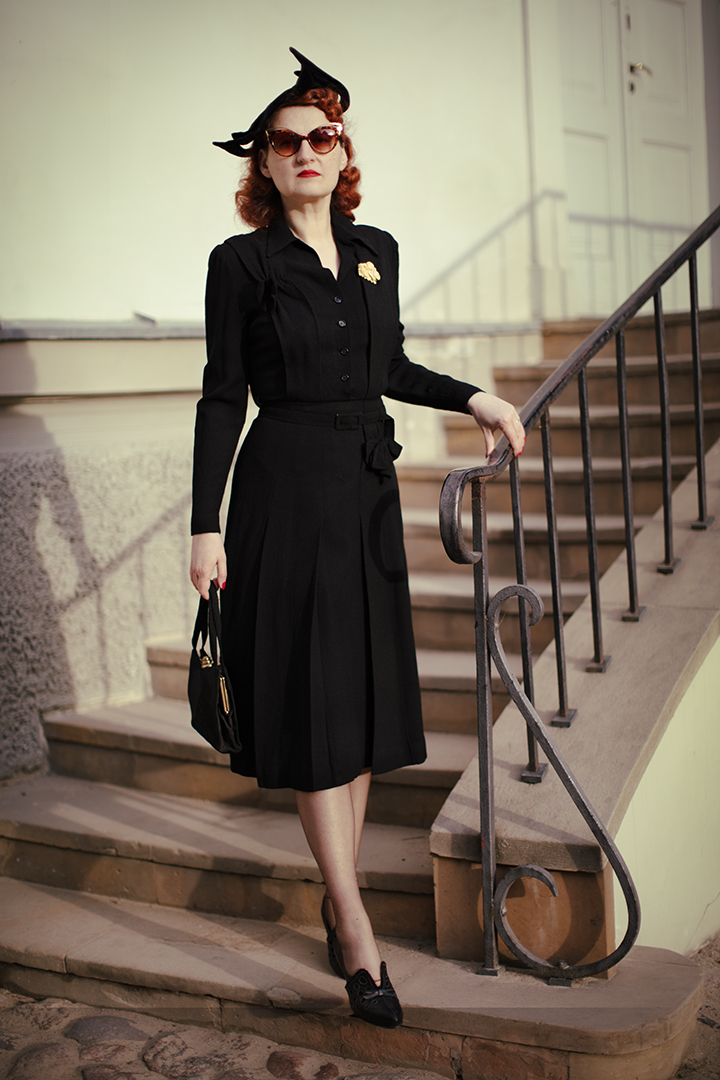
Here, I’m wearing original 1940s evening wear and wandering through the gardens of an 18th Century palace. It is, admittedly, not entirely historically accurate. For one thing, I’m committing a fashion offence: I’m wearing my hat after 6pm.
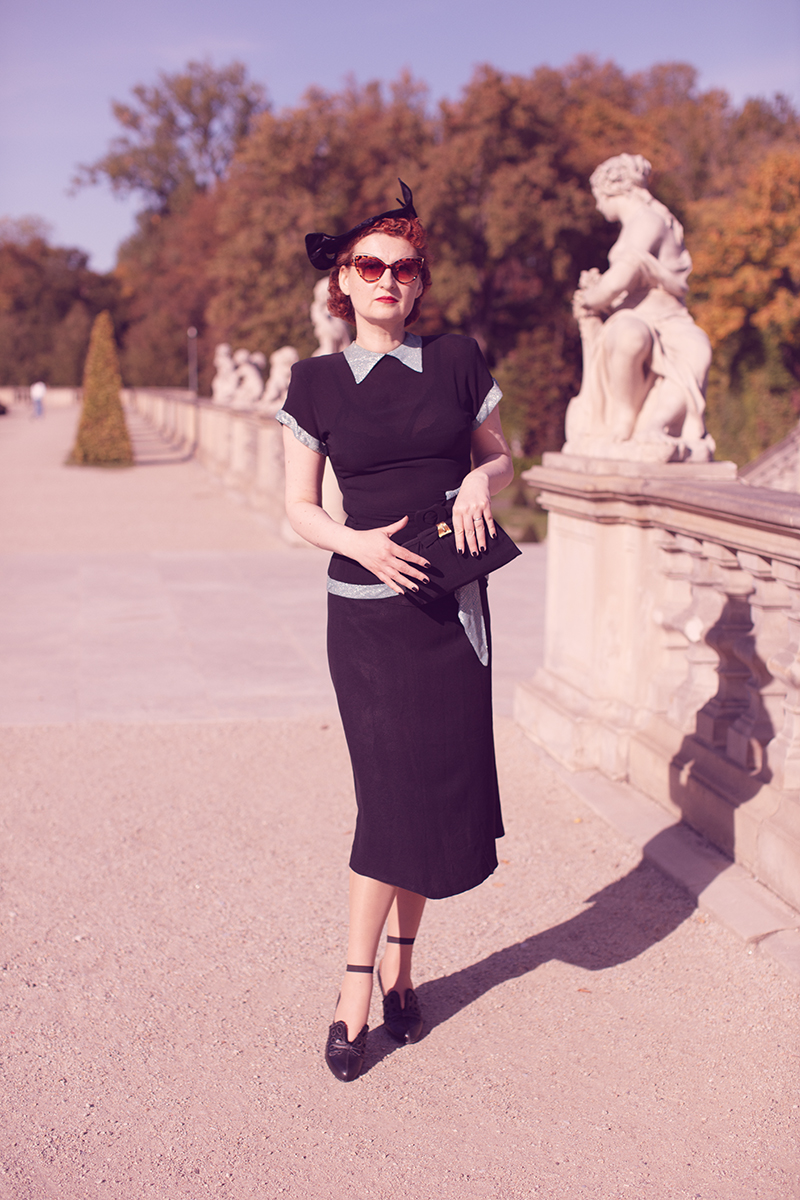
Historically questionable? Absolutely. And let’s not forget about the sunglasses, but as the song goes; “I wear my sunglasses at night so I can watch you weave, then breathe your story lines, and I wear my sunglasses at night so I can, so I can keep the track of the visions in my eyes…”
After more than 25 years of researching the fashion of the 1930s, 1940s and 1950s, I’m endlessly fascinated by the details of historical clothing: the labels, fabrics, silhouettes and the rules that governed how women actually dressed, but vintage fashion has never been only about dates and details for me.
It’s also about imagination!
About putting on an original garment and wondering who wore it before you. About imagining the places it might have been worn, the occasions it might have witnessed and the life that existed around it. And sometimes, it’s about allowing yourself to step into that fashion world for a little while. A dress can change the way you walk. A hat can alter your posture. For a few minutes, the gardens become a little more glamorous, the afternoon feels slightly more cinematic and the modern world pleasantly far away. This is my vintage world. And frankly, I rather like it here.
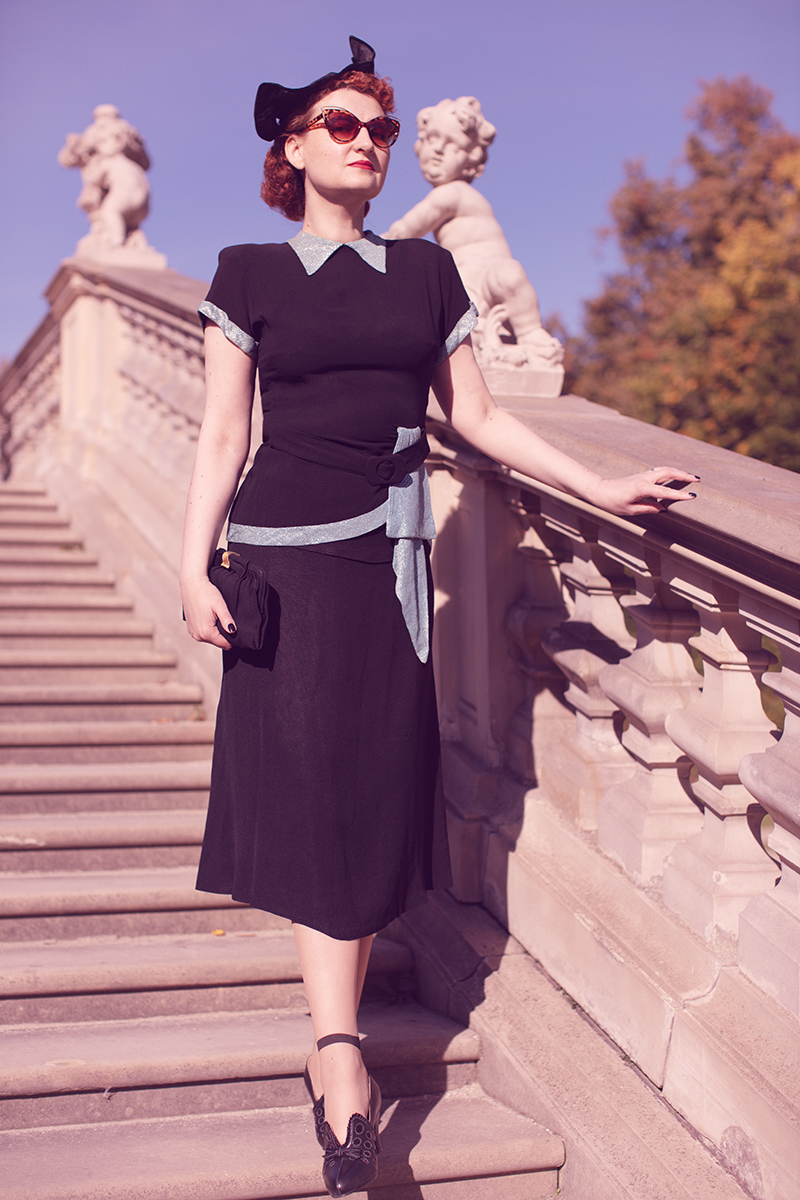
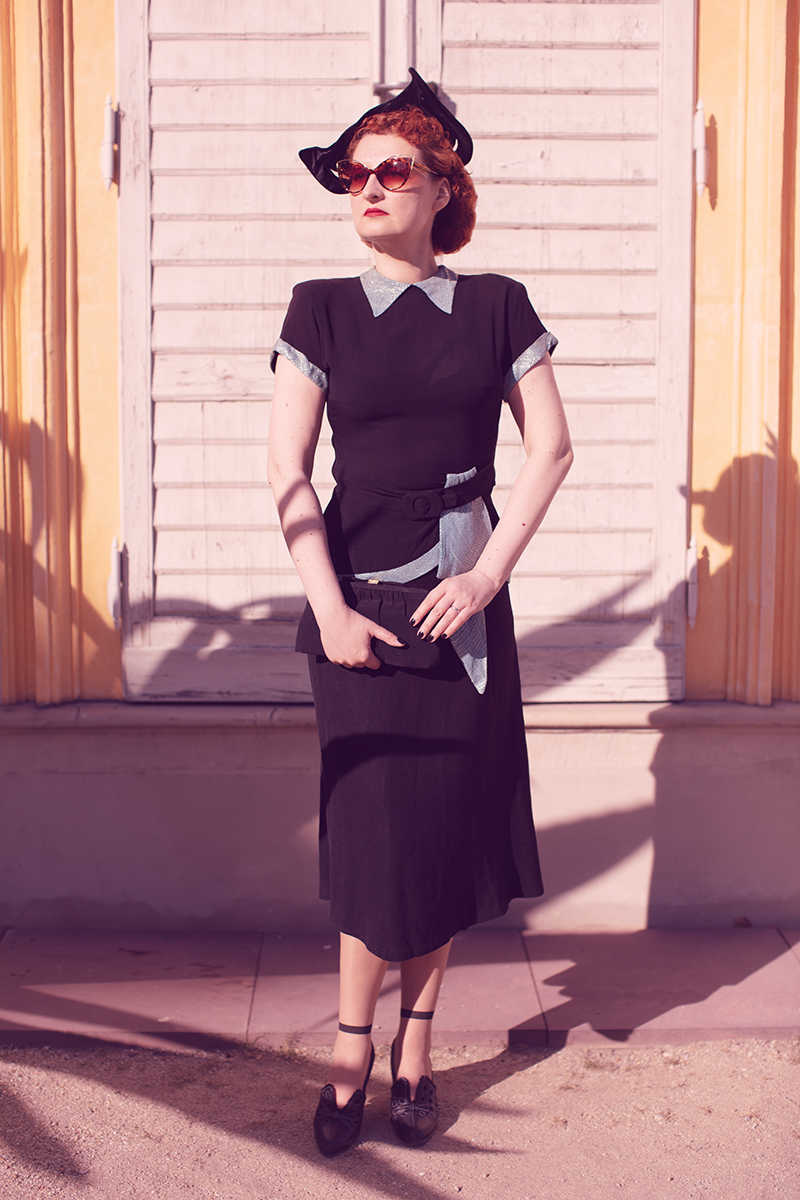
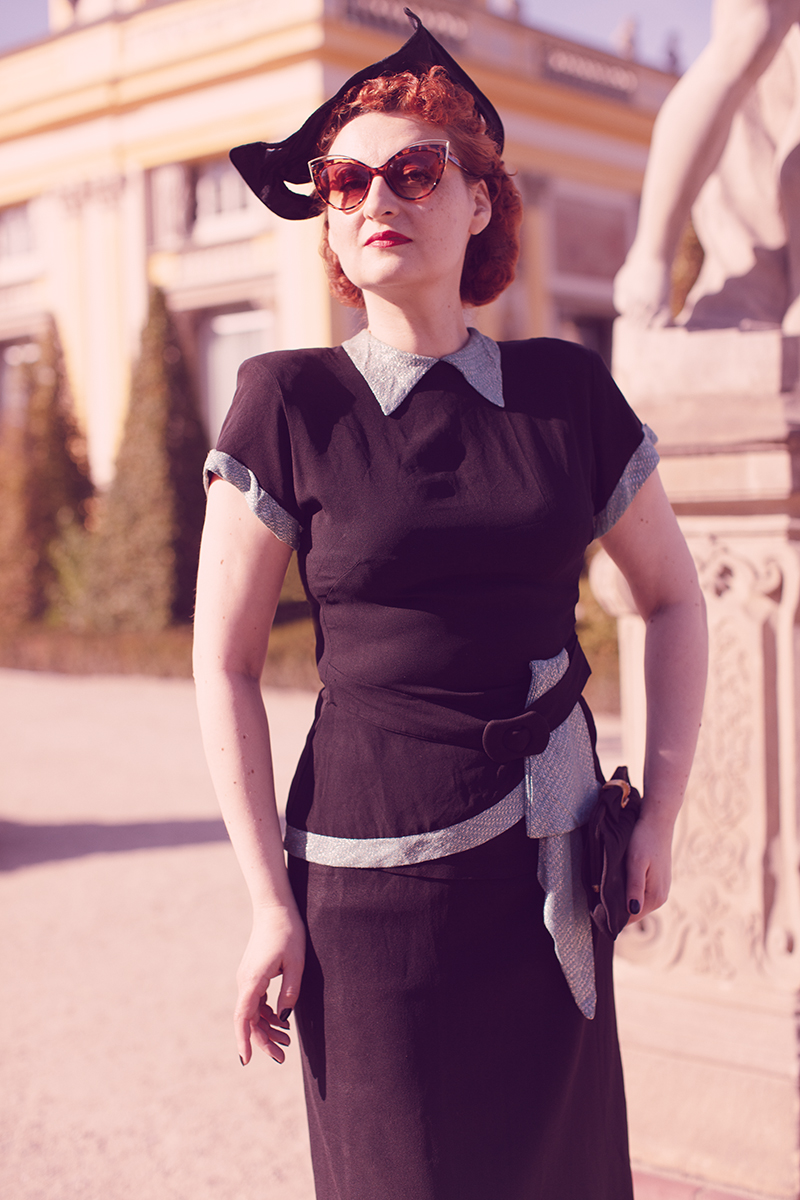
So without further ado, for my evening out I decided on an original 1940s skirt which I recently purchased from one of my favourite vintage sellers, Ehran Jade Vintage, paired with a fabulous1940s hat also from her shop. The glamorous 1940s evening top with Joan Crawford-like shoulders was an obvious choice and perfect match with the rest of the ensemble. I always buy vintage separates that I can mix and match, and let’s face it you can never go wrong with a classic black skirt. As for the Stella pumps with Spanish heels from the Memery brand, they are a faithful copy of classic 1930s shoes. The wonderful vintage purse is from Labellevintage,
Photography, Gregory Michael King.
CONSIDER DONATING TO MY BOOK FUND
If you enjoyed my article and found it useful, please consider supporting my book fund. Your contribution helps me continue researching the history of fashion, finding the books, paying for access to archives and other sources that make this work possible, and sharing what I discover with all of you without putting my articles behind a paywall.
Every donation, big or small helps keep the research going. And more importantly, it helps keep fashion history accesible to everyone. Thank you for helping me keep digging!